Even softened for English audiences, the title Dear Goddamned Friends carries a certain weary, affectionate roughness, doesn't it? The original Italian, Cari Fottutissimi Amici, hits even harder, a phrase drenched in the kind of exasperated love felt between people who've seen too much together. It perfectly sets the stage for Mario Monicelli's late-career return to the messy, tragicomic heart of Italian life, this time set against the backdrop of Tuscany in 1944 – a landscape scarred by war but stubbornly refusing to surrender its spirit. Finding this gem tucked away on a dusty VHS shelf felt like unearthing a poignant, slightly battered postcard from another time, a reminder of the unexpected discoveries the video store era often yielded.
### Punching Through the Rubble
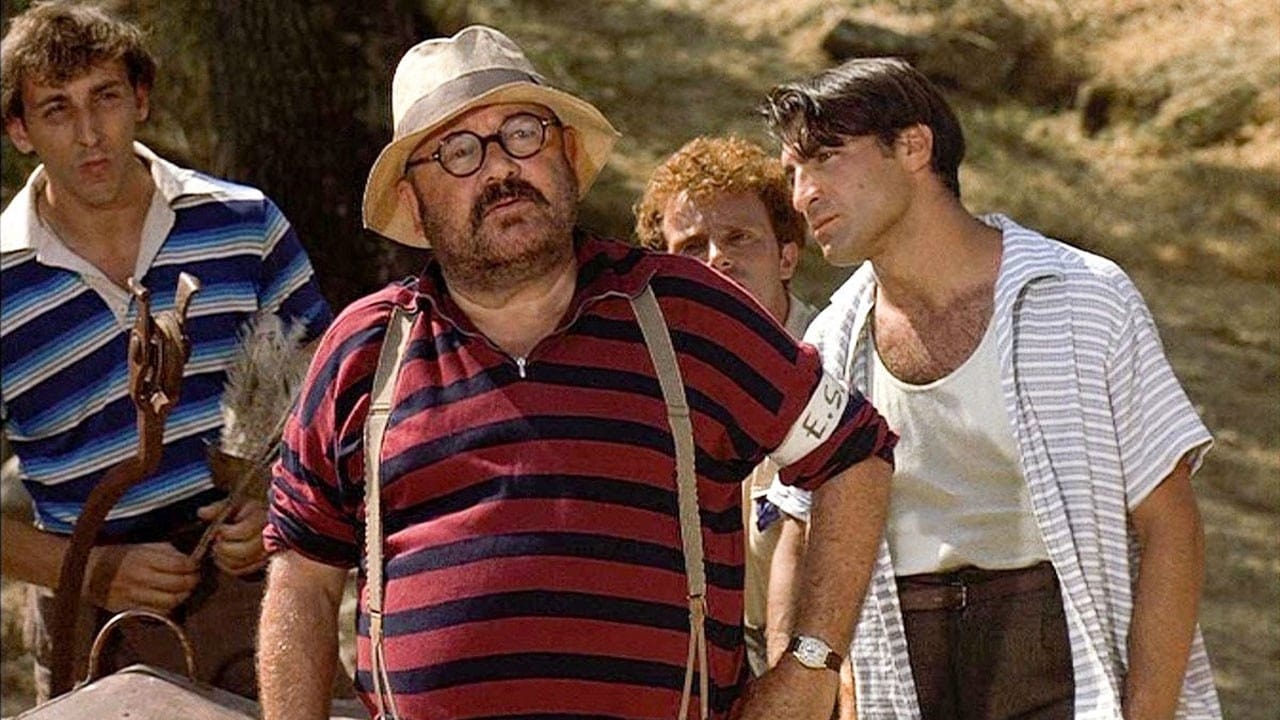
The premise itself feels uniquely Monicelli, a master craftsman of the commedia all'italiana who always found the human comedy nestled within hardship. We follow Dieci, played by the inimitable Paolo Villaggio, leading a ramshackle troupe of aging, down-on-their-luck boxers. Their ring isn't in smoky arenas but dusty village squares and makeshift camps. Their audience? Weary locals, displaced refugees, and Allied soldiers navigating the final, chaotic months of World War II in Italy. They travel the ravaged countryside, putting on fights that are less about athletic prowess and more about sheer survival, a fleeting distraction from the surrounding devastation. It's a narrative that immediately evokes echoes of Monicelli's earlier masterpieces like The Great War (1959), sharing that same blend of absurdity, camaraderie, and underlying melancholy in the face of conflict.
### The Maestro's Late-Career Stroke
By 1994, Mario Monicelli was an elder statesman of Italian cinema, yet Dear Goddamned Friends shows his touch remained remarkably astute. Working with his frequent collaborators, the legendary screenwriting team of Suso Cecchi D'Amico, Piero De Bernardi, and Leo Benvenuti (along with Monicelli himself), the film balances humour and pathos with a delicate hand. The jokes aren't setup-punchline gags; they arise organically from the characters' desperation, their petty squabbles, their attempts to maintain dignity (or at least make a quick buck) amidst the ruins.
Monicelli directs with an unfussy, observational style. He lets the Tuscan landscape, beautifully captured despite its wartime scars, breathe and become almost a character itself. There's a tangible sense of place, of heat, dust, and the weariness of a country holding its breath. He doesn't shy away from the grim realities – poverty, opportunism, the casual presence of death – but frames them within this narrative of scrappy endurance. It's a testament to his skill that a film dealing with such heavy themes can still feel strangely warm and, at times, genuinely funny.
### Villaggio and the Weary Warriors
Seeing Paolo Villaggio here is fascinating. While internationally known for his almost cartoonish creation, the perpetually hapless accountant Fantozzi, his role as Dieci is shaded with more grit and weariness. Yes, there are moments of physical comedy and his trademark hangdog expression, but Dieci is a survivor, a pragmatist trying to hold his motley crew together through sheer willpower and questionable schemes. It’s a performance that leverages Villaggio's comedic timing but anchors it in a palpable sense of history and struggle.
The ensemble cast around him, including a notable Massimo Ceccherini as one of the troupe members, feels authentic. Their interactions crackle with the lived-in familiarity of people thrown together by circumstance, bound by shared poverty and the strange profession of getting punched for a living. Their friendships are tested, frayed, and ultimately reaffirmed, embodying that "dear goddamned friends" spirit of the title – you might drive each other crazy, but you're all each other has.
### Echoes in the Dust (Retro Fun Facts)
Discovering this film often meant finding it with its slightly less profane English title, masking the earthier, more affectionate vulgarity of the original Italian Cari Fottutissimi Amici. That linguistic shift itself speaks volumes about cultural translation, doesn't it? It’s a detail that adds flavour, a reminder of the nuances often lost when films crossed borders in the VHS era.
This film marked one of Monicelli's later directorial efforts, premiering when he was nearly 80. It feels like a summation of sorts, revisiting themes of male bonding, aging, and resilience that echo his much-loved My Friends (Amici Miei, 1975), but transposed onto a starker historical canvas. It wasn't a huge international hit like his earlier works, but it did earn a competition slot at the prestigious 44th Berlin International Film Festival, a nod to Monicelli's enduring status. Filming on location in Tuscany undoubtedly added authenticity, but one can only imagine the challenges of recreating 1944 with the resources available for what was likely a modestly budgeted Italian production in the mid-90s.
### The Lingering Feeling
What stays with you after watching Dear Goddamned Friends? It’s not necessarily specific plot points, but the overall mood – a bittersweet blend of melancholy and defiant life force. It captures that strange human capacity to find moments of connection, laughter, and even absurdity in the darkest of times. Does it reach the absolute heights of Monicelli's legendary filmography? Perhaps not quite. It lacks the sheer iconic power of Big Deal on Madonna Street (1958) or the epic scope of The Great War. Yet, it possesses a unique, poignant charm all its own.
Watching it now, years after first stumbling upon it, evokes that specific nostalgia for discovering hidden cinematic corners through the local video store. It wasn't always about the blockbusters; sometimes the greatest reward was finding a film like this – flawed perhaps, quieter maybe, but deeply human and directed by a master nearing the end of his incredible journey. It asks us, subtly, how we find resilience when everything seems lost, and suggests the answer often lies in the flawed, frustrating, indispensable company we keep.
Rating: 7.5/10
Justification: While not Monicelli's absolute pinnacle, Dear Goddamned Friends is a beautifully observed, expertly crafted commedia all'italiana from a true master. Villaggio delivers a more grounded performance than usual, the ensemble cast is strong, and the film effectively balances its comedic and dramatic elements against a poignant historical backdrop. Its relative obscurity compared to Monicelli's classics and perhaps a slightly meandering pace keep it from top tier, but it's a deeply rewarding watch, rich with atmosphere and humanity.
Final Thought: A dusty, sun-baked, and ultimately moving testament to the absurdity of war and the stubborn refusal of the human spirit (and a good hustle) to be extinguished, delivered with the signature bittersweet wit of a cinematic giant.