Here we are again, fellow travellers through the flickering glow of the cathode ray tube. Tonight, let's slide a tape into the VCR that might feel different from the usual blockbuster fare we often celebrated back in the day. It’s a film whose sun-drenched visuals belie a chilling undercurrent, a story that unfolds like a lazy summer afternoon inexorably turning towards a devastating storm. I'm talking about Nikita Mikhalkov's powerful 1994 drama, Burnt by the Sun (Утомлённые солнцем).
### A Paradise Poised on the Precipice
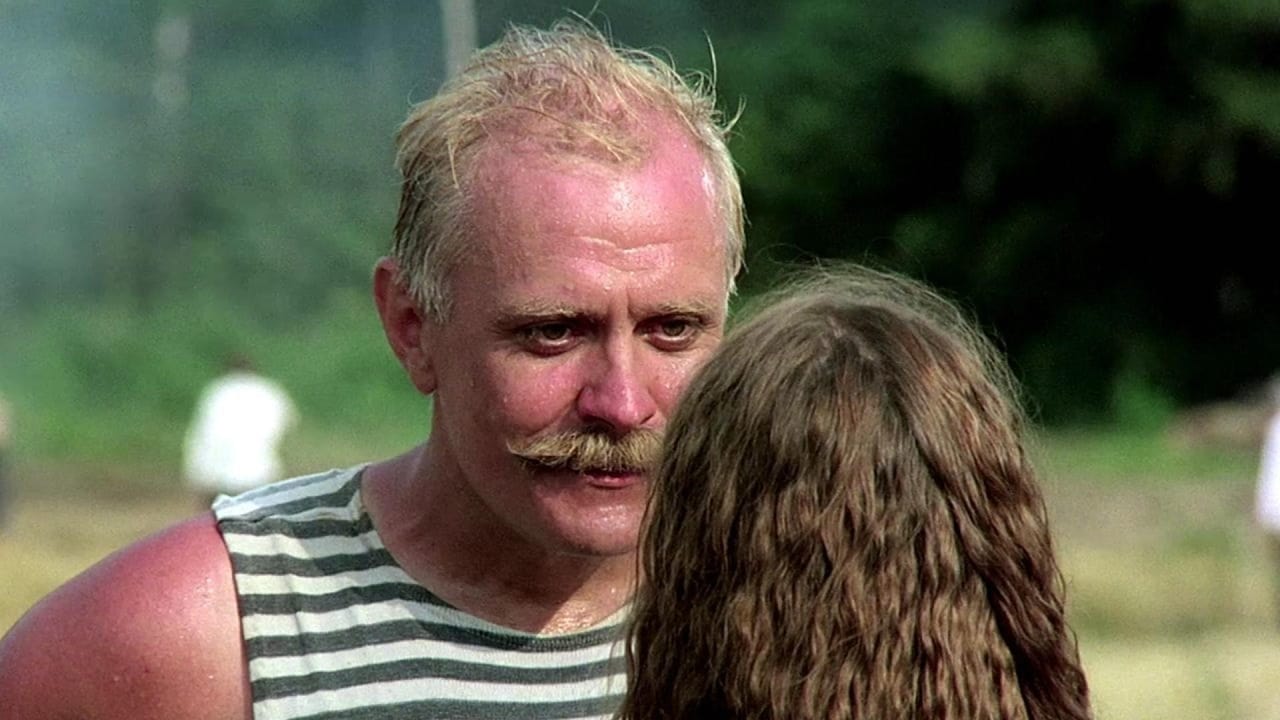
What strikes you first about Burnt by the Sun is the sheer, intoxicating beauty of its setting. We're dropped into the idyllic Russian countryside in the summer of 1936, specifically into the dacha (country house) of Colonel Sergei Petrovich Kotov (Nikita Mikhalkov himself). He’s a celebrated Old Bolshevik hero, a man basking in the glow of his revolutionary past, adored by his young wife Maroussia (Ingeborga Dapkūnaitė) and utterly idolised by their precocious daughter, Nadya (Nadezhda Mikhalkova, the director's own daughter, delivering a remarkably natural performance). The air is thick with the scent of pine, the warmth of the sun, the laughter of family and friends enjoying a seemingly perfect existence. It feels almost dreamlike, this pocket of warmth and affection shielded from the world's harsh realities. But this isn't just any summer; it's the summer of Stalin's Great Purge, and the paradise is terrifyingly fragile.
### The Serpent Enters Eden
The catalyst for the film’s slow-burn tension is the unexpected arrival of Mitya (Oleg Menshikov), Maroussia's former lover who vanished years ago. Charming, cultured, and effortlessly weaving himself back into the family dynamic, Mitya is initially presented as a figure of nostalgia, a ghost from a more romantic past. Menshikov is magnetic here; his performance is a masterclass in layered complexity. He can shift from playful pianist to unsettling observer in the blink of an eye. There's a coiled energy beneath his sophisticated veneer, a sense of purpose that slowly poisons the idyllic atmosphere. We soon learn he’s not just revisiting old haunts; he’s an agent of the NKVD, the Soviet secret police, and his presence spells doom for Kotov. This central dynamic between Kotov, the embodiment of established Soviet power (however illusory), and Mitya, the insidious instrument of its paranoia, drives the narrative towards its heartbreaking conclusion.
### Faces in the Sun, Shadows in the Soul
Mikhalkov directs with a patient, observant eye. He allows scenes to breathe, focusing on intimate moments – Kotov playing with Nadya, Maroussia's conflicted glances, the forced bonhomie of the extended family. This deliberate pacing makes the eventual shattering of their world all the more impactful. He uses the natural light beautifully, often contrasting the bright sunshine outdoors with the growing shadows within the dacha and within the characters' souls. Kotov, played by Mikhalkov with immense charisma and underlying vulnerability, represents a generation tragically blind to the monster it helped create. He genuinely believes his revolutionary credentials and heroic status make him untouchable, a fatal miscalculation in Stalin's Russia. His journey from revered patriarch to helpless victim is devastating to witness. Dapkūnaitė perfectly captures Maroussia's quiet fragility, caught between the imposing figures of her husband and her past love, sensing the danger but unable to grasp its full extent. And young Nadya, the innocent heart of the film, serves as our emotional anchor, her perspective highlighting the senselessness of the encroaching political terror.
### Retro Insights: Beyond the Surface
Finding Burnt by the Sun on a video store shelf in the mid-90s might have felt like discovering a hidden gem amidst the action and sci-fi staples. Its critical acclaim was significant – it deservedly won the Grand Prix at the 1994 Cannes Film Festival and the Academy Award for Best Foreign Language Film. This international recognition helped bring the painful history of the Stalinist purges, a topic often shrouded in silence or propaganda within the former Soviet Union, to a global audience. Filming took place near Moscow, lending an essential authenticity to the dacha setting, making it feel less like a set and more like a lived-in space about to be violated. The fact that Mikhalkov cast his own daughter adds another layer of poignancy; watching their on-screen interactions feels incredibly genuine, deepening the sense of personal loss when the state intrudes. For Oleg Menshikov, already a respected actor, his nuanced portrayal of the tormented Mitya became a career-defining role, showcasing his incredible range. One particularly chilling detail often discussed is the symbolism of the giant Stalin balloon seen early in the film – a looming, featureless presence casting a shadow even over moments of supposed joy, a stark visual metaphor for the pervasive fear of the era.
### A Legacy Etched in Light and Shadow
Burnt by the Sun stands as a monumental piece of post-Soviet cinema. It’s a deeply human story set against a specific, terrifying historical backdrop, exploring universal themes of love, betrayal, disillusionment, and the terrifying ease with which political ideology can crush individual lives. It reminds us how quickly perceived security can evaporate, how even heroes can become victims of the systems they champion. Its power lies not in overt violence (though the climax is brutal and unforgettable), but in the slow, creeping dread and the intimate portrayal of a family unknowingly on the edge of annihilation.
While Mikhalkov later revisited these characters in two much-maligned sequels (Burnt by the Sun 2: Exodus and Citadel), they unfortunately failed to capture the magic and emotional depth of the original. The 1994 film remains the definitive statement.
Rating: 9/10
This score reflects the film's masterful direction, outstanding performances (especially from Mikhalkov and Menshikov), its atmospheric richness, and its profound emotional and historical weight. It’s a beautifully crafted, deeply affecting film that earns its place as a modern classic. It might not be the lighthearted escapism often sought from the VHS era, but its power lingers long after the screen goes dark.
Burnt by the Sun doesn't just tell a story; it forces a confrontation with history and leaves you pondering the fragility of happiness in the face of unchecked power—a question as relevant today as it was in 1936. A haunting masterpiece well worth seeking out.