What happens when the straight path curves unexpectedly into darkness? That's the question shimmering under the heat haze of 1992's White Sands, a film that begins with the stark, almost surreal image of a corpse clutching a suitcase full of cash in the blinding New Mexico desert. It’s a scene that pulls you in immediately, not just with the promise of mystery, but with the deeper question of what you might do, standing there under that unforgiving sun, presented with a dead man's fortune and potentially, his life.

An Honest Man's Detour
Our way into this sun-bleached labyrinth is Ray Dolezal, played with compelling everyman anxiety by Willem Dafoe. Fresh off more intense roles like in Platoon (1986) or Born on the Fourth of July (1989), Dafoe here embodies a small-town Deputy Sheriff, a fundamentally decent man bored with routine. When he discovers the body and the $500,000, a moment of impulse – perhaps curiosity, perhaps a flicker of larcenous fantasy – leads him to assume the dead man's identity, Bob Spencer, to uncover the truth. It's a classic noir setup, the seemingly small transgression that spirals inexorably downward. Dafoe is masterful at portraying the gradual erosion of Ray's certainty, the way the borrowed identity starts to fit a little too comfortably, the danger becoming almost addictive. We see the conflict warring within him – the lawman wrestling with the imposter. Doesn't that initial, seemingly small step off the path often prove the most fateful?
Shades of Grey in the Blinding Sun

Of course, no neo-noir worth its salt is complete without figures lurking in the shadows, even when those shadows are cast by the intense desert light. Enter Lane Bodine (Mary Elizabeth Mastrantonio) and Gorman Lennox (Mickey Rourke). Mastrantonio, who we knew from the depths of The Abyss (1989) or the sharp edges of Scarface (1983), plays Lane with an alluring ambiguity. Is she a victim, a conspirator, a femme fatale, or something else entirely? Her performance keeps you guessing, her motivations shifting like the desert sands themselves.
And then there's Rourke. By 1992, his screen presence was already legendary, carrying the weight of films like Angel Heart (1987) and Barfly (1987). As arms dealer Gorman Lennox, he smolders. It’s not a large role in terms of screen time, but Rourke imbues Lennox with a laid-back menace that feels genuinely dangerous. He doesn’t need to shout; his quiet intensity and unpredictable energy are enough. The film also features a notable supporting turn from Mimi Rogers and an early-career appearance by Samuel L. Jackson as an FBI agent, sharp and focused even then, years before Pulp Fiction (1994) would make him a superstar.
Crafting the Mirage
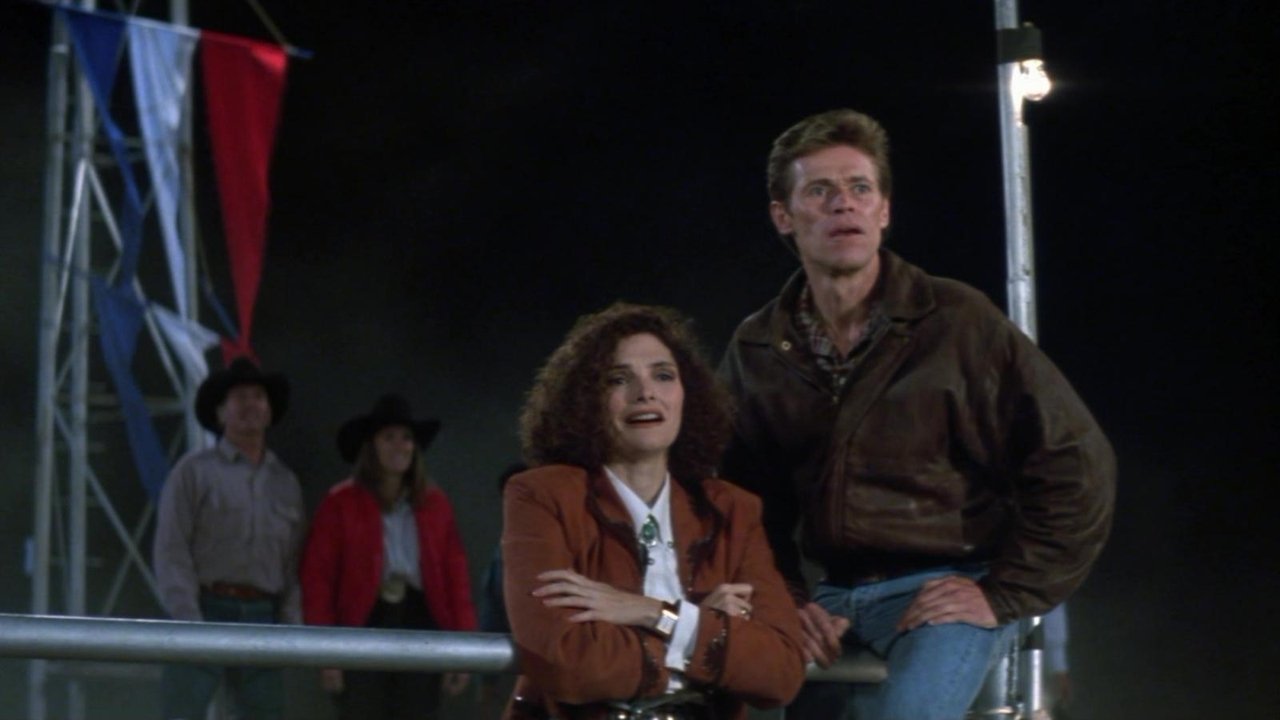

Director Roger Donaldson, who’d already proven his thriller credentials with the excellent No Way Out (1987), brings a slick, professional polish to the proceedings. He uses the vast, empty landscapes of New Mexico – including filming within the actual White Sands National Monument, surely a logistical challenge involving careful coordination to protect the fragile gypsum dunes – to create a palpable sense of isolation and exposure. The stark whites and deep blues captured by cinematographer Peter Menzies Jr. make the setting a character in itself, beautiful and lethal. You feel the heat, the dust, the sense that there's nowhere to hide.
Interestingly, White Sands was penned by Daniel Pyne as an original screenplay, not an adaptation, which was somewhat less common for mainstream thrillers at the time. While the plot, involving FBI stings, illegal arms deals, and double-crosses, can occasionally feel a bit tangled – a criticism leveled at it upon release – it's the atmosphere and the central character's moral descent that truly resonate. The film arrived with a decent $22 million budget but sadly didn't find its audience initially, pulling in only about $10 million domestically. I distinctly remember seeing the cool, minimalist VHS box art on the rental store shelves, promising a different kind of thriller, perhaps more cerebral than explosive. It felt like one of those discoveries you'd make browsing the aisles, hoping for something a little off the beaten path.
Retro Fun Facts: Sand in the Gears
- The challenges of shooting in White Sands weren't just logistical; the fine gypsum sand reportedly caused issues with camera equipment.
- While Dafoe feels perfect as the conflicted lawman, it’s always intriguing to wonder if other actors were considered for these kinds of morally grey 90s roles.
- The film's somewhat convoluted plot might explain its mixed critical reception (Roger Ebert, for instance, gave it a thumbs down, citing plot holes despite praising the setup). It was a film perhaps more admired for its mood than its mechanics.
- Remember the suitcase full of cash trope? It was practically a subgenre in the 80s and 90s! White Sands uses it as the classic catalyst, the object that tempts fate.
Lingering Heat
White Sands might not be a perfect thriller. Its narrative threads sometimes knot rather than weave seamlessly, demanding close attention (perhaps even a second viewing). But what lingers long after the credits roll isn't necessarily the intricate plot mechanics, but the oppressive atmosphere, the stark beauty of the locations, and Willem Dafoe's gripping portrayal of a good man navigating a treacherous moral landscape. It captures that specific early 90s feel – slicker than the 80s, perhaps a bit more cynical, exploring the darkness beneath the polished surfaces. It asks us to consider the allure of the unknown, the danger of impulse, and how easily one can get lost when stepping off the marked trail. Isn't the possibility of transformation, even a dangerous one, sometimes morbidly fascinating?

Rating: 7/10
Justification: While the plot can be overly complex and occasionally strains credibility, the film scores high on atmosphere, Donaldson's assured direction, stunning cinematography, and compelling performances, particularly from Dafoe. It’s a solid, stylish neo-noir that effectively uses its unique setting and captures a specific 90s thriller mood, making it a worthy rediscovery on VHS (or your format of choice).
Final Thought: A sun-scorched journey into moral ambiguity, White Sands remains a potent reminder that sometimes the most dangerous mirages are the ones we create for ourselves.