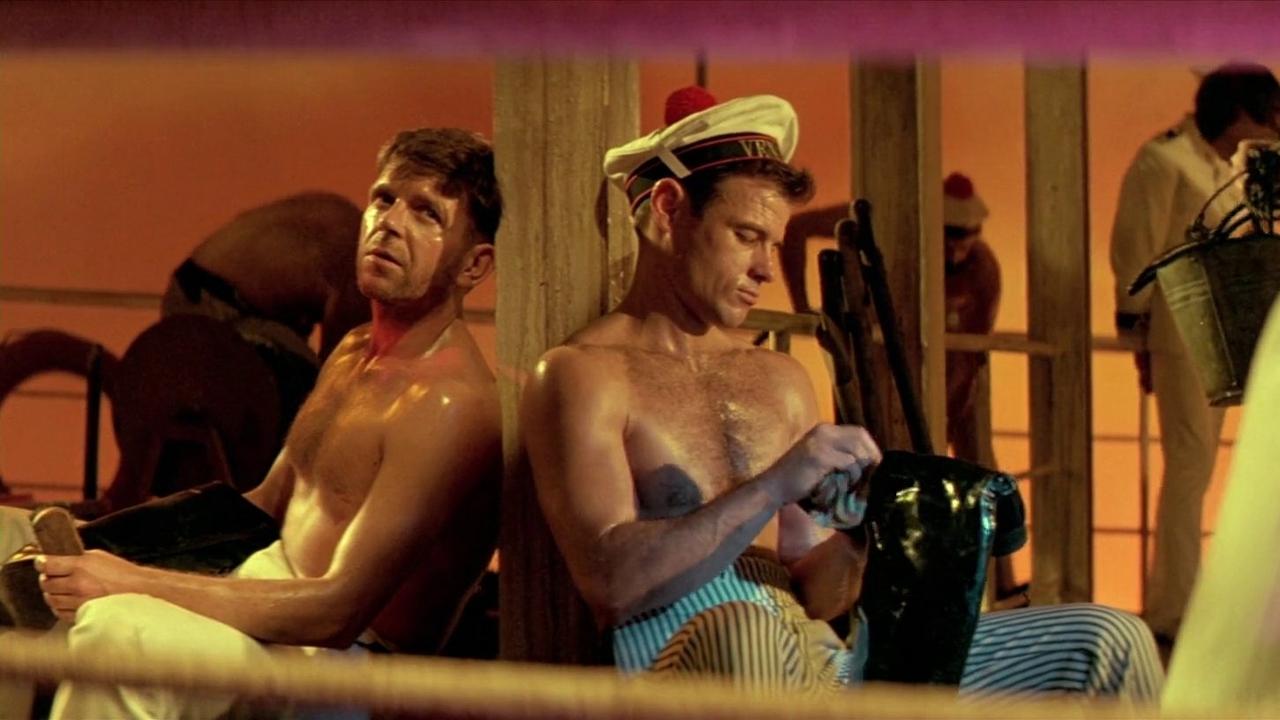
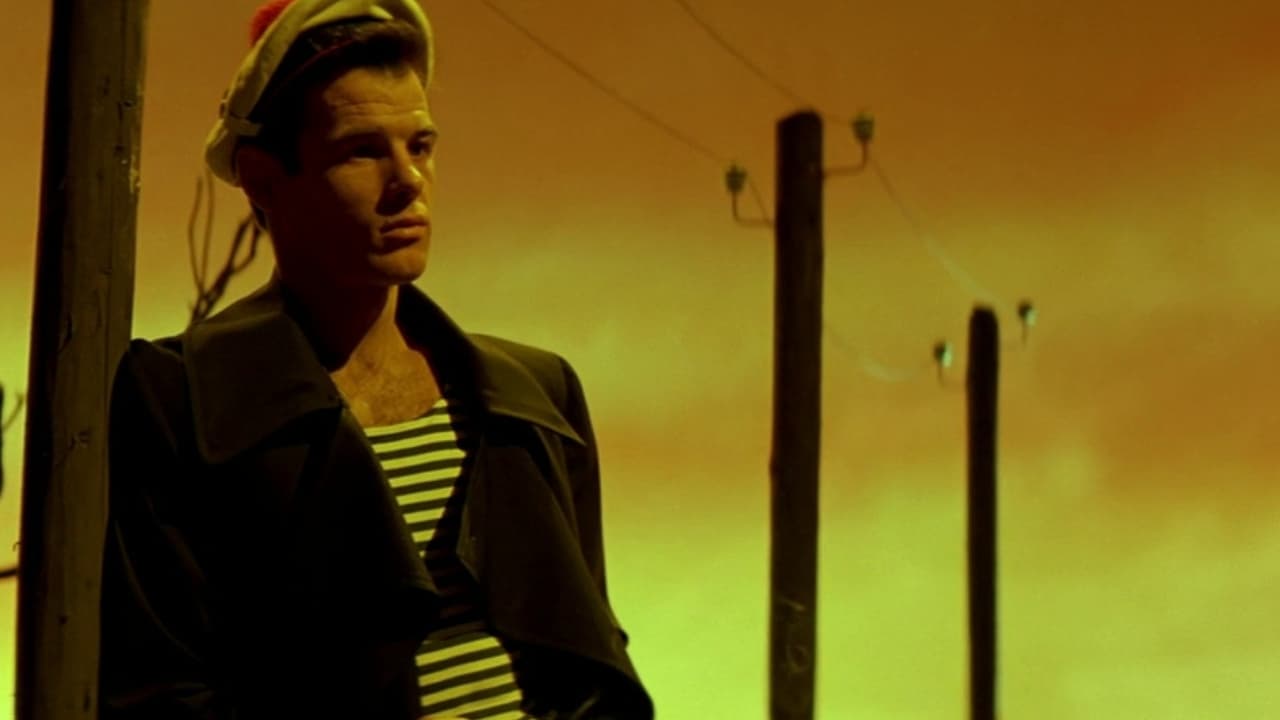
It begins with the light. An oppressive, artificial, almost painterly orange glow saturates the port town of Brest, bouncing off glistening cobblestones that never saw rain and muscular bodies that seem sculpted from myth rather than flesh. Watching Rainer Werner Fassbinder’s Querelle (1982) is less like viewing a film and more like stepping into a fever dream staged within a highly theatrical, hermetically sealed world. There's no attempt at realism here; instead, Fassbinder plunges us headfirst into a realm governed by stylized desire, betrayal, and the dangerous magnetism of the titular sailor. It feels less like a story unfolding and more like a ritual being enacted.
A Port of Unbound Desire
Based on Jean Genet's controversial 1947 novel Querelle of Brest, the film follows Querelle (Brad Davis), a handsome, amoral sailor whose arrival in Brest triggers a chain reaction of lust, violence, and shifting power dynamics. He navigates relationships with his commanding officer, Lieutenant Seblon (Franco Nero), the brooding, dominant Nono (Günther Kaufmann), owner of the local brothel La Féria, and Nono’s wife Lysiane (Jeanne Moreau), who reads tarot cards and sings mournful torch songs about the destructive nature of love. Querelle’s own brother, Robert (Hanno Pöschl), is also entangled in this web, creating a volatile mix of fraternal tension and shared secrets. The plot, such as it is, serves primarily as a framework for exploring raw, often uncomfortable, truths about human connection – or the lack thereof.
The Weight of a Final Testament
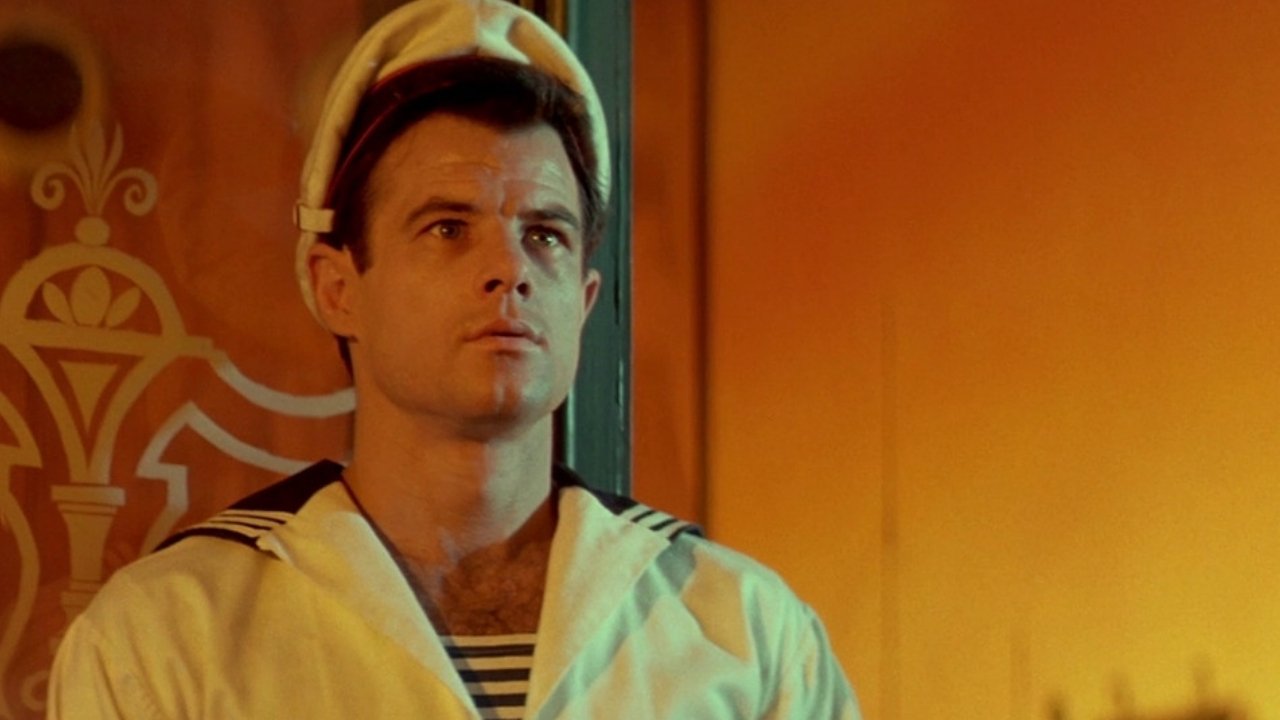
It’s impossible to discuss Querelle without acknowledging the profound melancholy surrounding its creation. This was Rainer Werner Fassbinder’s final film, completed just before his tragically early death at age 37. Knowing this casts a long, unavoidable shadow over the viewing experience. Does the film feel like a summation, a final, desperate howl into the void? Perhaps. Fassbinder, a notoriously prolific and provocative filmmaker associated with the New German Cinema, adapts Genet’s dense, philosophical text with a visual language entirely his own. The deliberate theatricality – the obvious studio sets painted in lurid hues, the phallic architecture, the ritualistic dialogue – pushes against cinematic convention. It forces us to confront the artifice, making us constantly aware that we are watching a construction, a deliberate exploration of ideas rather than a simple narrative. This choice wasn't merely stylistic; Fassbinder reportedly wanted to create a dreamlike space where the raw, often taboo, desires explored in Genet's text could manifest without the constraints of realism.
Performance Under Pressure
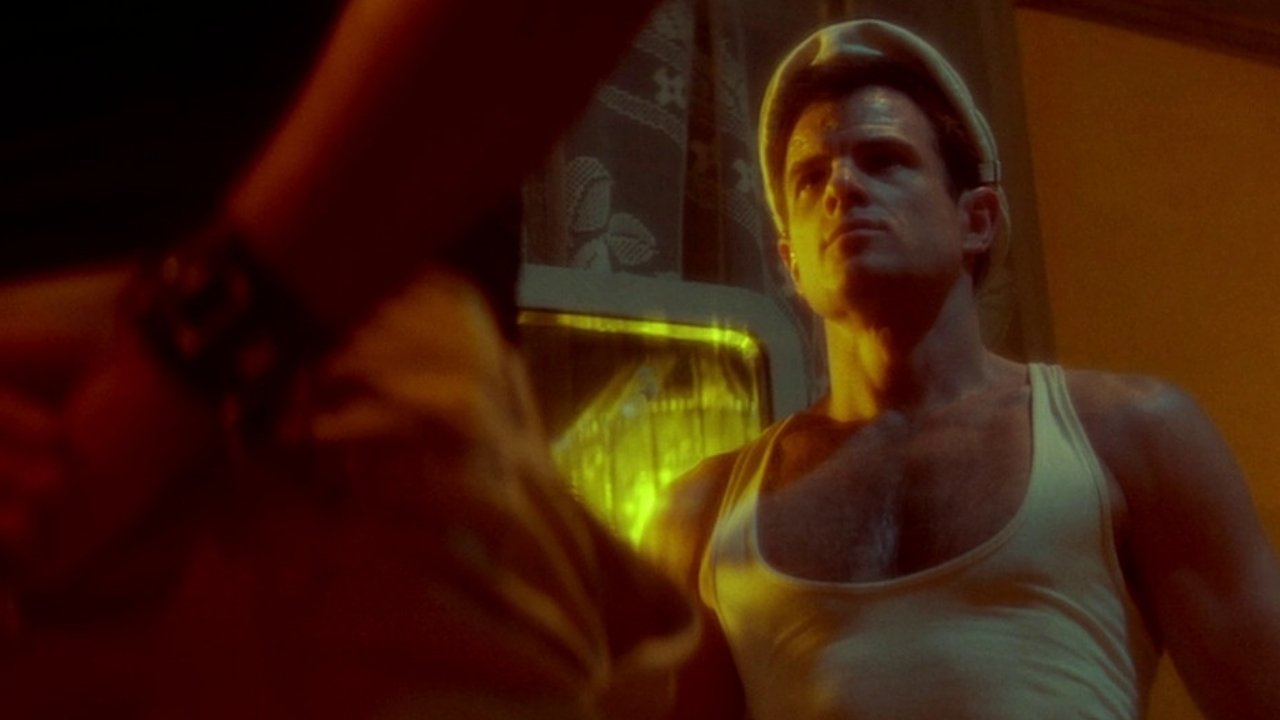
At the center stands Brad Davis, an actor still largely defined by his harrowing turn in Midnight Express (1978). Taking on Querelle was an incredibly bold move, particularly in the early 80s. His portrayal is fascinating – physically imposing yet emotionally opaque, a vortex of charisma and danger. Querelle is desired by almost everyone he encounters, yet his own motivations remain ambiguous, shifting between calculated manipulation and moments of vulnerability. Davis embodies this duality compellingly, navigating the film’s explicit themes with a commitment that feels both brave and unsettling. Watching him, especially knowing his own life would later be tragically cut short by AIDS, adds another layer of poignancy.
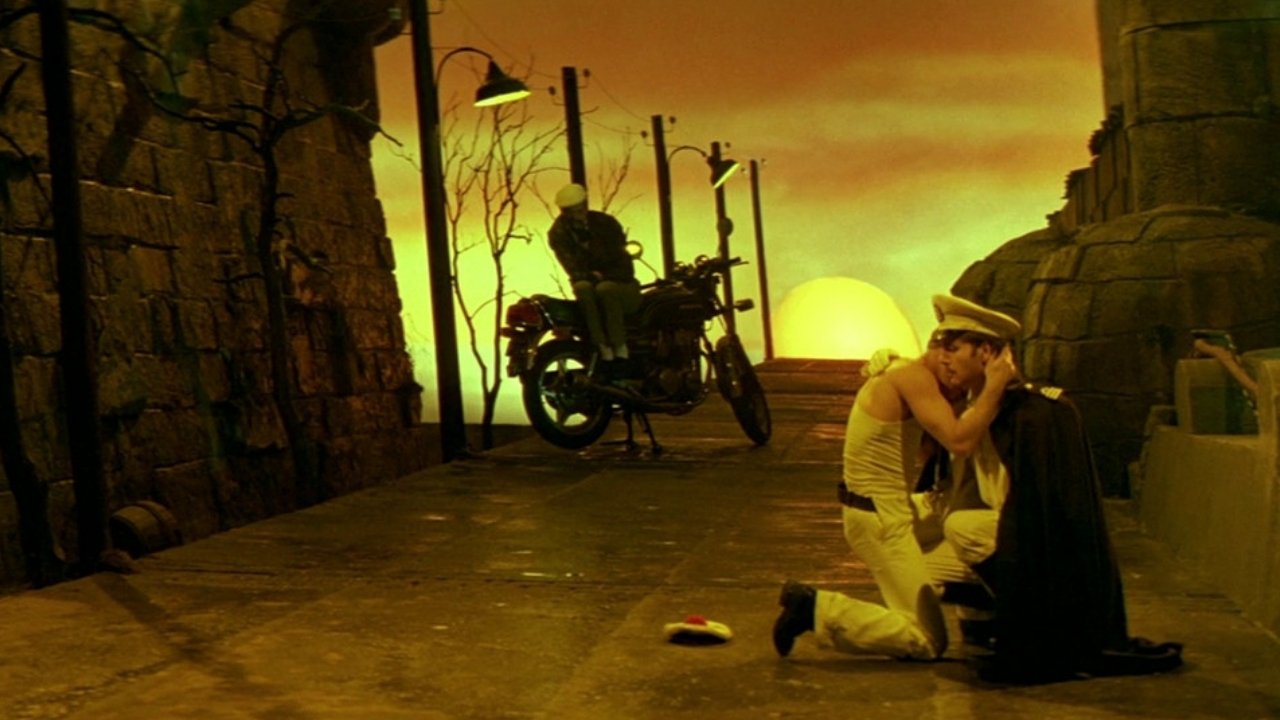
Surrounding him, Franco Nero brings a tormented dignity to Lieutenant Seblon, his longing for Querelle palpable beneath his uniform's stoicism. And then there's the legendary Jeanne Moreau. As Lysiane, she’s a figure of weary wisdom and faded glamour, her musical interludes ("Each Man Kills the Thing He Loves") providing a thematic chorus that underlines the film's bleak romanticism. Her presence lends a touch of classic European arthouse weight to the proceedings. A fascinating piece of trivia: Moreau was initially hesitant about the explicit nature of the film but was ultimately convinced by Fassbinder's artistic vision, becoming a staunch defender of the controversial work.
Beyond the Surface: A World Built of Symbols
Querelle isn’t a film easily digested or forgotten. Its power lies in its atmosphere and its unflinching gaze into the darker corners of sexuality and power. The highly stylized production design, overseen by Rolf Zehetbauer, isn't just background; it's an active participant. The recurring phallic symbols, the intense, often non-naturalistic color palette dominated by oranges, blues, and yellows – these aren't accidental. They contribute to a feeling of heightened reality, a space where internal desires are made external. Some found this approach alienating, even distancing, upon its release. The film received notoriously divisive reviews, celebrated by some as a masterpiece of queer cinema and condemned by others as self-indulgent or even repellent. It certainly wasn’t a box office smash, reportedly costing around DM 4 million (a significant sum for a German arthouse film then) and struggling to find a wide audience, especially in the US due to its themes and X rating.
For those discovering films beyond the multiplex mainstream on VHS back in the day, stumbling upon Querelle felt like finding forbidden knowledge. Its distinct visual signature and challenging content made it stand out dramatically from the usual rental fare. It wasn't comfortable viewing, certainly not something you'd casually put on with just anyone, but it demanded attention. It sparked conversations, arguments even. Doesn't that kind of provocation mark a certain kind of artistic success, even if it alienates some?
Rating and Final Reflection
Querelle is a difficult film to rate conventionally. It's undeniably a work of significant artistic ambition, visually stunning in its unique way, and anchored by brave performances. Fassbinder's final statement is potent, haunting, and refuses easy categorization. However, its deliberate artificiality, challenging themes, and sometimes opaque narrative can be alienating. It demands patience and a willingness to engage with its confrontational style. For its sheer audacity, visual mastery, and importance as Fassbinder's final, uncompromising vision, it warrants respect.
Rating: 7/10
Justification: The score reflects the film's status as a challenging, polarizing, yet undeniably significant piece of arthouse cinema. Its strengths lie in Fassbinder's unique directorial vision, the bold performances (especially Davis), the unforgettable visual style, and its unflinching exploration of complex themes. It loses points for its deliberate distancing effect and narrative opacity, which can make it a demanding, even frustrating, watch for some viewers. It's a film more respected and analyzed than perhaps universally loved, but its artistic merit and place in film history (and Fassbinder's legacy) earn it a solid score.
What lingers most powerfully after the credits roll on Querelle isn't necessarily the plot, but the suffocating beauty of its manufactured world and the lingering echo of Fassbinder's final, challenging gaze into the abyss of human desire. It remains a potent, unsettling artifact from a filmmaker who burned brightly and left us far too soon.