It’s a strange sort of vertigo watching someone gamble away centuries of history, isn't it? Not in a casino, under gaudy lights, but within the supposedly regulated, hallowed halls of finance. Rogue Trader drops us right into that dizzying freefall, capturing a moment in the mid-90s when one young man’s unchecked ambition brought Britain’s oldest merchant bank crashing down. Rewatching it now, years removed from the headlines, the film feels less like a simple cautionary tale and more like a slightly frantic snapshot of a system teetering on the brink, embodied entirely by one dangerously charismatic individual.

The Golden Boy Flies Too Close to the Sun
Based on the autobiography of Nick Leeson, the film charts his meteoric rise within Barings Bank, landing a plum job running derivatives trading on the Singapore International Monetary Exchange (SIMEX). Director James Dearden, who memorably explored obsession and consequence as the writer of Fatal Attraction (1987), crafts a narrative that initially buzzes with the energy of newfound success. Young Nick Leeson, portrayed with an almost unnerving blend of boyish charm and simmering panic by Ewan McGregor, seems unstoppable. He’s making money hand over fist, living the high life with his wife Lisa (Anna Friel, stepping confidently from British TV stardom into this complex role). The film effectively captures that initial rush, the sense of being untouchable that often precedes a catastrophic fall.
But beneath the surface, mistakes are being made. Small errors snowball, concealed within the infamous "88888" error account. What starts as patching over minor losses spirals into a desperate, high-stakes gamble to recoup ever-growing deficits. The film excels in depicting this gradual descent, the mounting pressure visible in McGregor's increasingly frayed performance. You see the charm weaponized to deflect scrutiny, the quick thinking devolve into frantic improvisation. It’s a compelling portrayal of how easily ambition can curdle into recklessness when oversight is lax and the rewards seem limitless.
McGregor's Manic Energy
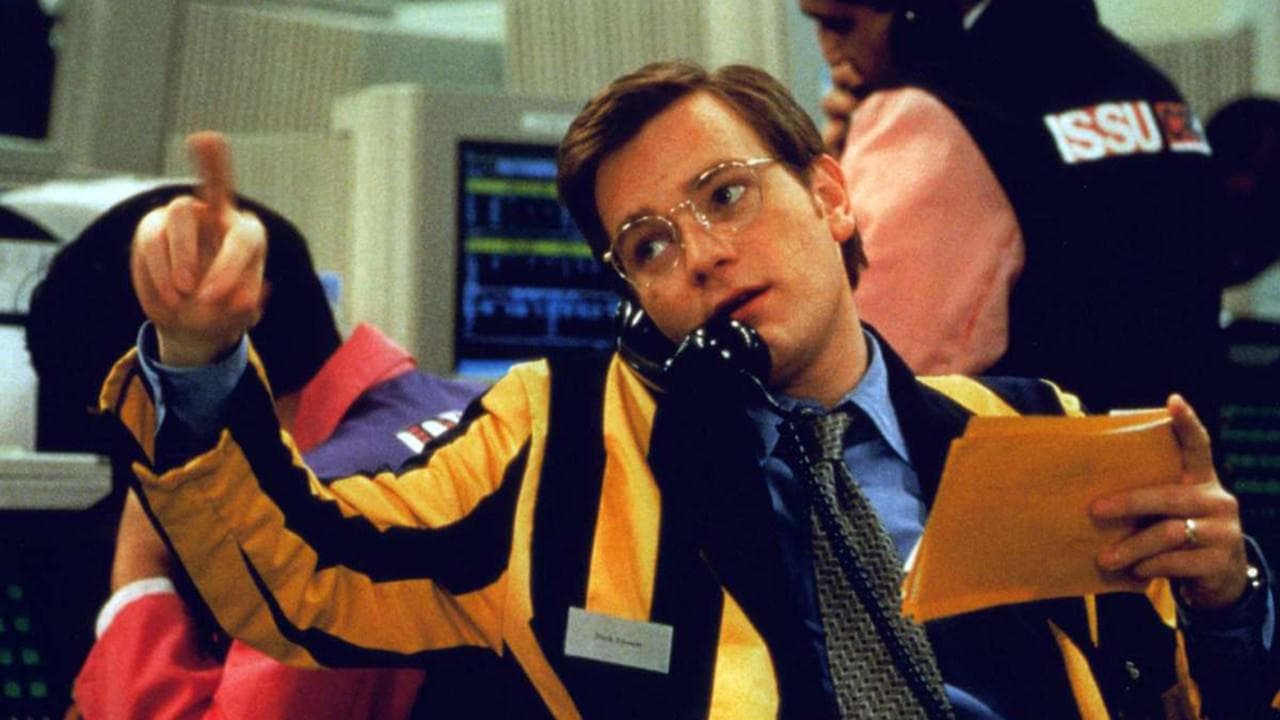
The absolute anchor of Rogue Trader is Ewan McGregor. This was right in his post-Trainspotting (1996) sweet spot, an actor crackling with screen presence. He doesn’t just play Leeson; he inhabits his skin, conveying the intoxicating allure of success and the gut-wrenching fear of discovery, often in the same breath. Watching him navigate the chaotic trading floor – McGregor apparently learned some of the frantic hand signals used on the actual SIMEX floor for authenticity – you believe both his initial prowess and his eventual unraveling. It’s a performance that requires navigating arrogance, desperation, charm, and outright panic, and McGregor delivers, making Leeson magnetic even as his actions become increasingly indefensible. Anna Friel provides a crucial counterpoint as Lisa, initially swept up in the excitement but gradually sensing the encroaching disaster. Her performance grounds the film, reminding us of the human cost beyond the balance sheets.
Truth Stranger Than Fiction (Retro Fun Facts)
The story behind Rogue Trader is as fascinating as the film itself. It’s almost hard to believe this relatively modest production (financed independently for around £8 million, roughly $12.8 million back then, after major studios reportedly passed) tackled such a globally significant event. Nick Leeson himself, having served his prison sentence, actually visited the set during filming – imagine the surreal experience for McGregor, portraying the man standing just off-camera. Director James Dearden not only directed but also co-wrote the screenplay, adapting Leeson's own book. While the film takes some dramatic liberties, its depiction of the lax oversight and the ease with which Leeson concealed billions in losses feels chillingly plausible, perhaps even more so in retrospect. It’s a stark reminder of how vulnerable even long-established institutions can be. Filming took place on location in Singapore, London, and Malaysia, adding a layer of authenticity to the globe-trotting nature of high finance. While not a box office smash (grossing under £1 million in the UK initially), its subject matter and McGregor's performance ensured it found its audience on home video – many of us likely first encountered Leeson's story via a rental tape or DVD.
The Buzz and the Bustle
Dearden does a decent job capturing the frantic energy of the trading floor, that unique environment of shouting, signaling, and high-pressure decisions made in seconds. The film conveys the arcane nature of derivatives trading without getting bogged down in excessive jargon, focusing instead on the human drama unfolding amidst the flickering screens and ringing phones. It might lack the slickness of later financial thrillers like Margin Call (2011) or the satirical bite of The Wolf of Wall Street (2013), but Rogue Trader possesses a grounded quality, a sense of witnessing a specific moment in time – the late 90s cusp, where technology was advancing rapidly but oversight perhaps hadn’t quite caught up. It feels less like a stylized Hollywood take and more like a dramatized documentary at times, which works largely in its favor.
Lingering Questions
What stays with you after watching Rogue Trader? For me, it’s the unsettling ease of the deception. How could one person accumulate such staggering losses without anyone noticing sooner? It forces a reflection on accountability, not just of the individual, but of the systems designed to prevent such disasters. Does the pursuit of profit inevitably create blind spots? The film doesn't offer easy answers, but it certainly leaves you pondering the human element within the vast, impersonal machinery of global finance. It’s a story that, unfortunately, remains relevant.
***
Rating: 7/10
Justification: Rogue Trader earns its score primarily through Ewan McGregor's powerhouse performance and the inherently compelling nature of its true story. It successfully captures the pressure-cooker atmosphere of the trading floor and Leeson's psychological spiral. While perhaps not a stylistic masterpiece, and occasionally feeling like a well-made TV movie, its grounded approach and focus on character keep it engaging. It effectively translates a complex financial meltdown into accessible human drama, making it a noteworthy late-90s entry often overlooked.
Final Thought: A gripping reminder from the VHS shelves that sometimes the most devastating crashes aren't caused by malice, but by ambition flying blind, fueled by a system that looked the other way until it was far too late.