There's a certain kind of unease that settles in when you know you're trapped, not necessarily by bars, but by words, implications, and the unblinking stare of authority. This feeling permeates every frame of Craig Monahan's 1998 Australian thriller, The Interview. It begins simply enough – a man, Eddie Fleming, brought into a drab police station about a potentially stolen car. But what unfolds over the next 100-odd minutes is anything but simple; it’s a masterclass in escalating tension, a psychological chess match played out in the stark confines of an interrogation room. Forget flashy action or elaborate set pieces; this is cinema distilled to its potent core: dialogue, performance, and the gnawing uncertainty of truth.
Under the Microscope
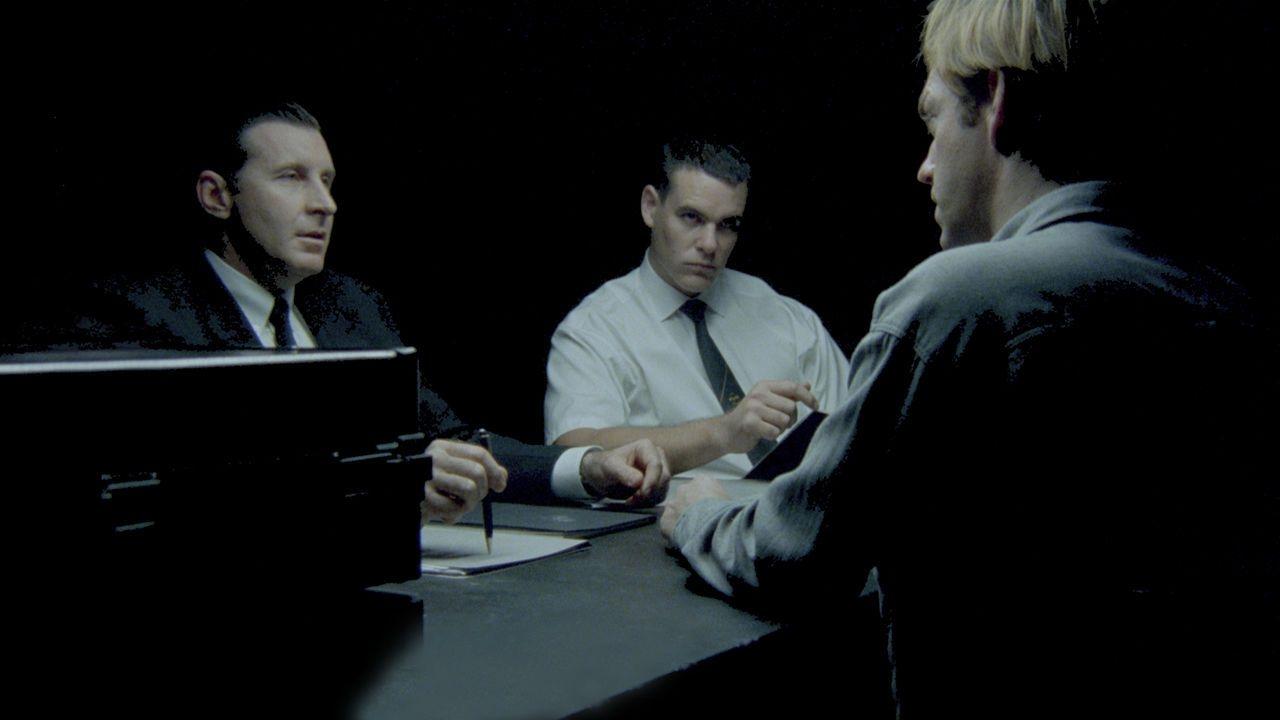
The film deliberately throws us off balance from the start. Eddie Fleming, portrayed with extraordinary nuance by Hugo Weaving, isn't presented as a hardened criminal or an obvious innocent. He's just... a man. Unemployed, slightly dishevelled, possessing a quiet nervousness that could be interpreted as guilt, anxiety, or simply the reaction of any ordinary person thrust into an intimidating situation. We watch him, scrutinise him, just as Detective Sergeant John Steele (Tony Martin) and his younger colleague, Detective Wayne Prior (Aaron Jeffery), do. The genius lies in how Monahan, who also co-wrote the script, forces us into the position of observer, constantly re-evaluating Eddie based on every stammer, every averted gaze, every sudden flash of defiance.
It’s almost impossible to discuss The Interview without focusing on Hugo Weaving. This performance arrived just before his global explosion as Agent Smith in The Matrix (1999), and watching it now feels like witnessing a coiled spring of talent about to unleash itself. He embodies Eddie's discomfort, the subtle shifts from apparent compliance to simmering resentment. Is he a victim of circumstance, caught in a bureaucratic nightmare? Or is there something darker lurking beneath that increasingly agitated surface? Weaving keeps us guessing, delivering a portrayal that feels utterly authentic, stripped of actorly vanity. It’s a performance built on small gestures, flickering expressions, and a palpable sense of internal struggle. It deservedly swept the Best Actor award at the Australian Film Institute (AFI) Awards that year, alongside Best Film and Best Director for Craig Monahan in his impressive feature debut.
The Walls Close In
The setting itself becomes a character. The interrogation room is intentionally unremarkable – bland walls, functional furniture, the omnipresent hum of recording equipment (remember those actual tapes?). This minimalism isn't just a budgetary necessity (the film was famously shot on a shoestring budget of around AUD $1.1 million in just 16 days), it's a crucial element of the film's power. There’s nowhere for Eddie, or the audience, to hide. The claustrophobia intensifies as the questioning, led primarily by the outwardly calm but relentless Steele, burrows deeper. Tony Martin provides the perfect counterpoint to Weaving – controlled, probing, employing psychological tactics that range from feigned empathy to outright accusation. The dynamic between the two actors is electric, a slow-burn duel where words are the only weapons, yet the potential for combustion feels ever-present.
What begins as questioning about a car gradually hints at something far more serious. The script, co-written by Monahan and Gordon Davie, is a marvel of construction. Information is teased out, retracted, reinterpreted. Flashbacks, presented as Eddie’s potentially unreliable recollections or perhaps police hypothesis, muddy the waters further. We are constantly asked: Whose version of events do we trust? Does the pressure of the interrogation itself warp perception, potentially creating guilt where none existed? It taps into fundamental questions about power, manipulation, and the terrifying subjectivity of truth within institutional systems. Doesn't this careful dissection of an interrogation resonate with anxieties we still harbour about authority and justice?
A Gem Unearthed from the Tape Shelf
Finding The Interview on VHS back in the day felt like uncovering a hidden treasure, distinct from the usual blockbuster fare crowding the shelves. It wasn't loud or explosive, but its quiet intensity left a far deeper mark. It's a film that relies on patience and attention, rewarding the viewer with intricate character work and sustained suspense. Monahan’s direction is assured, never resorting to cheap tricks to maintain tension. He trusts his actors and his script, allowing the psychological drama to unfold organically. The film's critical success in Australia was significant, proving that powerful, internationally resonant cinema could be crafted with limited resources but immense talent.
The deliberate ambiguity of the ending is perhaps its most talked-about aspect, and rightly so. It refuses easy answers, leaving the viewer to sift through the evidence, the performances, the lingering doubts. What stays with you isn't necessarily a definitive conclusion, but the unsettling feeling of having witnessed a man systematically dismantled, regardless of his ultimate guilt or innocence. It’s a testament to the film’s enduring power that debates about Eddie Fleming’s true nature continue decades later.
---
Rating: 9/10
The Interview stands as a high watermark for Australian thrillers and a showcase for one of Hugo Weaving's most compelling performances. Its brilliance lies in its minimalist execution, razor-sharp script, and the suffocating tension it masterfully builds within the confines of a single room. The acting is superb across the board, but Weaving's portrayal of a man under immense psychological pressure is simply unforgettable. While its deliberate pace and ambiguity might not satisfy everyone, for those who appreciate taut, intelligent, character-driven suspense, this film is a near-perfect exercise in psychological warfare. It earns its high rating through sheer craft, sustained tension, and a central performance that burrows under your skin.
Final Thought: Long after the tape stopped whirring, the questions posed by The Interview linger – a stark reminder of how fragile truth can be when placed under pressure.