Two souls adrift in a landscape of faded hopes – that's the stark image that lingers long after the credits roll on Homer and Eddie (1989). This isn't the kind of film you stumbled upon expecting high-octane thrills or laugh-a-minute antics, even with James Belushi's name on the VHS box, often associated with comedies like About Last Night... (1986) around that time. Instead, it's a detour down a dusty, sun-bleached road of desperation, a challenging character study that perhaps sat uneasily on the rental shelves between brighter, louder fare.
An Unlikely Pair on a Desperate Path
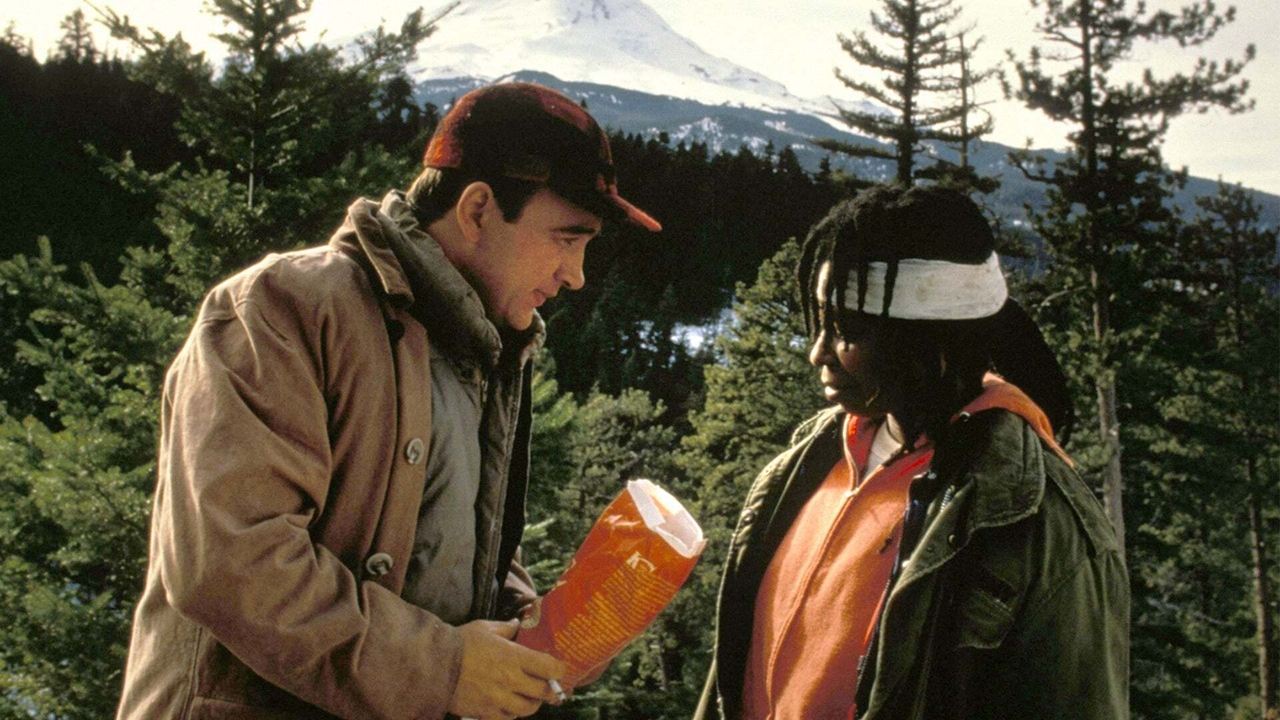
The premise itself is stark: Homer Lanza (James Belushi) has a developmental disability and, as we soon learn, a terminal brain tumor giving him weeks to live. His singular goal is to travel cross-country to see his estranged parents one last time. Eddie Cervi (Whoopi Goldberg) is an escaped psychiatric patient, volatile, unpredictable, and carrying deep scars from a traumatic past. A chance, chaotic encounter throws them together, forging an unlikely, often fraught, alliance built on shared vulnerability and circumstance. Their journey becomes less a scenic road trip and more a raw scramble through the underbelly of late-80s America, encountering indifference, cruelty, and fleeting moments of unexpected connection. Directed by the formidable Russian filmmaker Andrei Konchalovsky, fresh off the intense survival thriller Runaway Train (1985) and, rather notoriously, shortly before being fired from the set of Tango & Cash (also 1989), Homer and Eddie feels like an intentional pivot towards something smaller, grittier, more focused on human frailty.
Navigating Challenging Performances
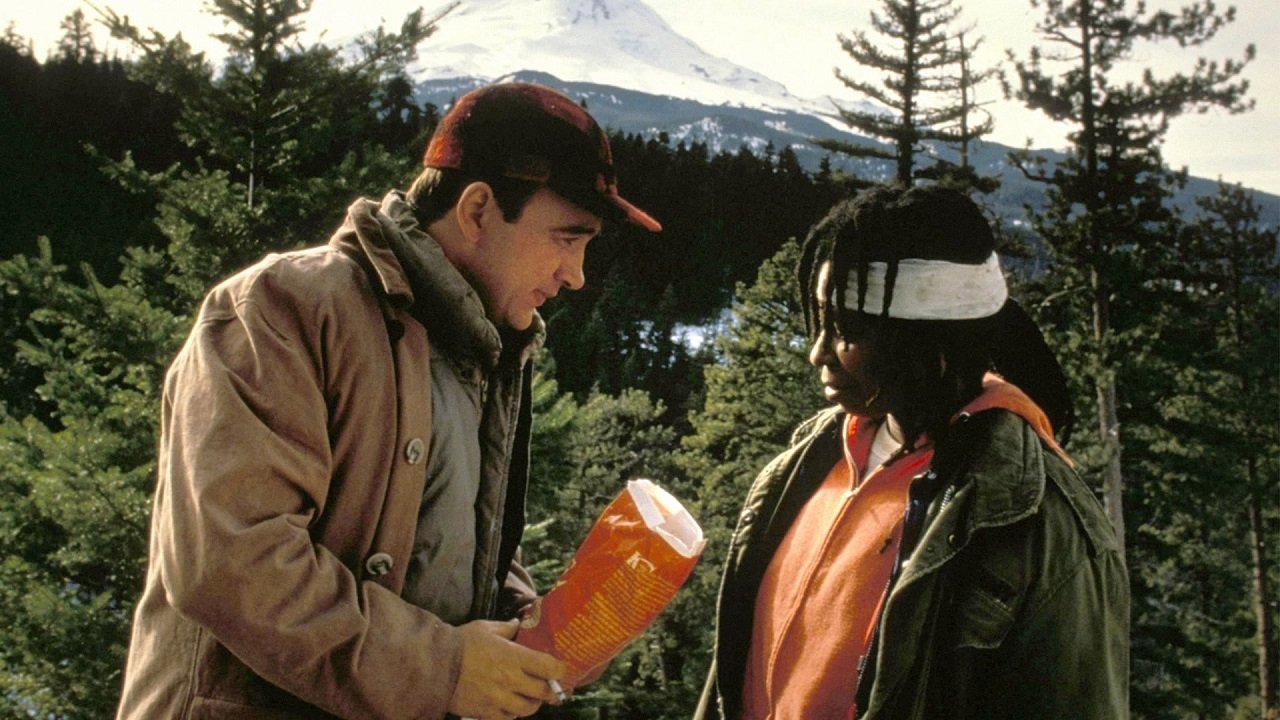
The film rests squarely on the shoulders of its leads, and it’s a demanding task. Whoopi Goldberg, already having proven her dramatic power with her Oscar-nominated role in The Color Purple (1985), is utterly compelling as Eddie. She doesn't shy away from the character's abrasive edges or profound instability. There's a palpable danger simmering beneath her surface, born of pain and mistrust, but Goldberg allows glimpses of a wounded humanity to peek through, making Eddie more than just a collection of symptoms. It’s a raw, fearless performance that anchors the film’s emotional core.
James Belushi's casting as Homer was certainly against type. Known primarily for his comedic persona, taking on a role like Homer, a character defined by cognitive challenges and impending mortality, was a significant dramatic stretch. Does he fully succeed? It’s complicated. Belushi approaches the role with undeniable sincerity, avoiding caricature and focusing on Homer's gentle nature and simple desires. There are moments where his portrayal feels truly authentic and moving. Yet, perhaps inevitably, glimpses of the familiar Belushi persona occasionally flicker through, momentarily disrupting the delicate balance. It’s a brave attempt, however, and his chemistry with Goldberg, shifting between antagonistic and tenderly protective, forms the heart of their shared odyssey. We also get a brief but memorable appearance from the unique Karen Black as Homer's mother, adding another layer of poignant disillusionment near the journey's end.
A Journey Through Bleak Terrain

Konchalovsky doesn’t offer easy answers or sentimental escapes. The film confronts difficult themes head-on: mental illness, terminal disease, poverty, the casual cruelty of strangers, and the search for dignity in seemingly hopeless situations. Filmed largely on location across Oregon and Nevada, the dusty highways, dilapidated motels, and forgotten small towns provide a fitting backdrop – a landscape reflecting the characters' internal states. Konchalovsky, who mentioned wanting to explore "simple human relationships" and find beauty even in "ugliness" after his experiences with bigger Hollywood productions, certainly leans into the latter here. The atmosphere is often relentlessly downbeat, punctuated by moments of violence or despair that can be hard to watch. This unwavering commitment to bleakness is perhaps the film’s greatest strength and its most significant hurdle for viewers. Is it exploitative? I don't believe so. It feels more like an honest, if difficult, portrayal of lives lived on the absolute margins.
An Oddity with Unexpected Acclaim
Thinking back, Homer and Eddie was likely a perplexing find at the video store. It wasn't easily categorized – not quite a drama, definitely not a comedy, too raw for a simple tearjerker. Its critical reception at the time was largely mixed-to-negative, with many critics faulting its tonal shifts and unrelenting grimness. And yet, in a fascinating turn, the film won the prestigious Golden Seashell for Best Film at the San Sebastián International Film Festival in 1989. This contrast highlights the film's challenging nature – perhaps too abrasive for mainstream tastes but possessing a raw power recognized by festival jurors. It’s one of those interesting retro tidbits: a film dismissed by many finding significant acclaim elsewhere, suggesting a depth that rewards patient viewing. Belushi’s commitment to the role, wanting to prove his dramatic range, adds another layer to its peculiar history. It wasn't a box office success, barely making a dent against the bigger releases of '89, cementing its status as a cult curio rather than a mainstream hit.
Final Thoughts
Homer and Eddie is undeniably a tough watch. It demands patience and a willingness to sit with uncomfortable truths and flawed characters navigating a harsh world. It’s not a film that offers easy catharsis or feel-good resolutions. Yet, there's an undeniable power in Goldberg's fierce performance and a touching sincerity in Belushi's portrayal of Homer. Konchalovsky crafts a stark, unflinching vision that, while potentially uneven, feels deeply personal. It explores the desperate need for human connection in the most unlikely of circumstances. For viewers seeking something beyond typical 80s fare, this challenging road movie offers a raw, poignant, and ultimately unforgettable journey.
Rating: 6/10 - The score reflects the film's significant strengths, particularly Goldberg's powerhouse performance and its brave, unflinching tone, balanced against its demanding bleakness, occasional unevenness in Belushi's against-type casting, and a narrative that some might find overly grim or meandering. It's a film whose ambition and raw emotion are undeniable, even if the execution isn't flawless.
It remains a curious artifact of the late VHS era – a reminder that even amidst the blockbusters, Hollywood occasionally took detours down roads less travelled, leaving behind difficult but strangely resonant stories.