Here's a review for "Fire with Fire" (1986) in the style of VHS Heaven:
***
There's a particular kind of quiet intensity that defined certain dramas nestled amongst the brighter, louder fare on the video store shelves of the mid-80s. Sometimes, a film would catch your eye not because of explosions or neon graphics on the cover, but because of the gaze exchanged between its leads, promising something a little deeper, maybe a little more dangerous. Fire with Fire (1986) was one such film, a tape I remember renting more than once, drawn back by its potent blend of forbidden romance and the smoldering atmosphere of the Pacific Northwest. It wasn't just another teen movie; it carried a weight, a sense of consequence, that stuck with you long after the VCR whirred to a stop.
Worlds Apart, Drawn Together

The premise itself feels almost archetypal, like a modern fable filtered through an 80s lens. Joe Fisk (Craig Sheffer) is doing time in a juvenile forestry camp, a place of enforced routine and simmering discontent amongst young men paying their dues. Lisa Taylor (Virginia Madsen) attends a nearby Catholic girls' school, a world equally structured by rules and expectations, albeit of a different sort. A chance encounter in the vast, indifferent woods that separate their confined worlds sparks an immediate, impossible connection. It’s a classic setup – the wrong side of the tracks meets the sheltered innocent – but Fire with Fire invests it with a surprising sincerity. The script, credited to several writers including Warren Skaaren (who notably worked on the scripts for Tim Burton's Batman and Beetlejuice), takes its central relationship seriously, grounding the escalating drama in the tangible longing between its protagonists.
The Chemistry That Ignites
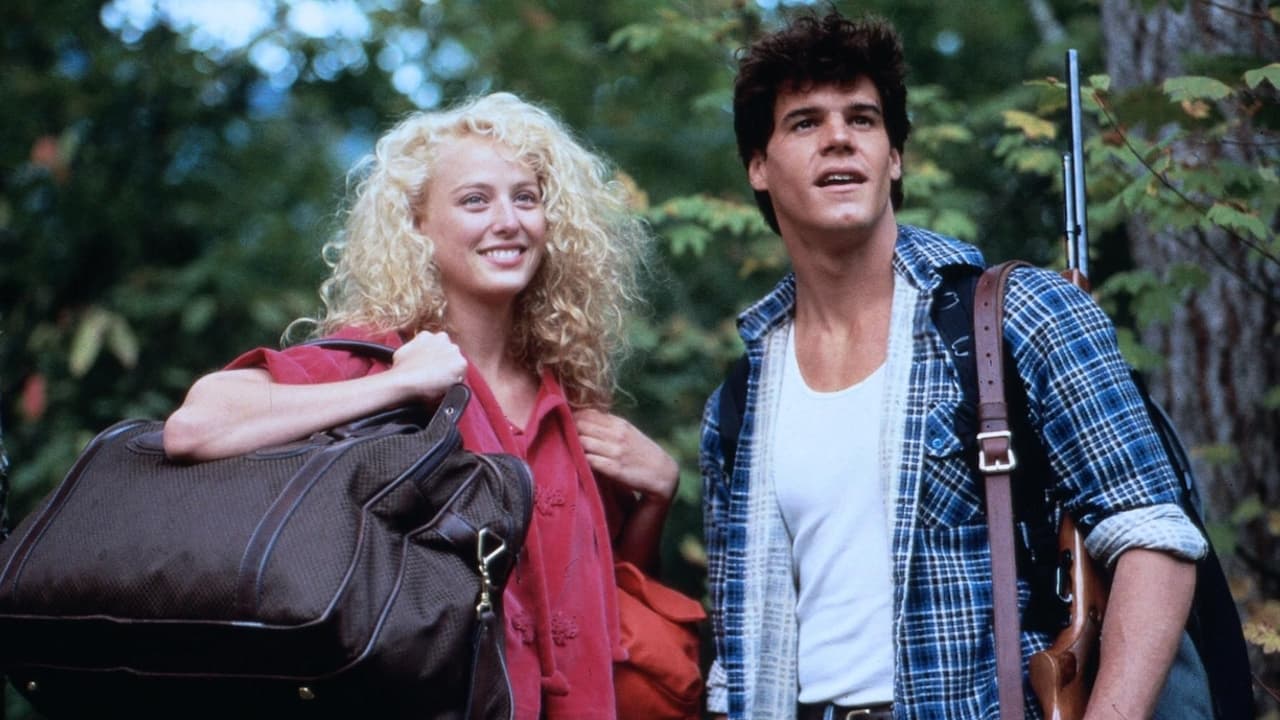
What truly elevates Fire with Fire beyond its potentially formulaic roots is the palpable chemistry between Craig Sheffer and Virginia Madsen. Sheffer, with his brooding intensity and guarded vulnerability, perfectly embodies Joe's desperation for something more, something real outside the fences of the camp. You see the conflict in his eyes – the pull towards Lisa versus the harsh reality of his situation. Madsen, in one of her early leading roles after making an impression in films like Dune (1984), is luminous. She captures Lisa's awakening, the burgeoning courage beneath the demure schoolgirl facade. It’s not just infatuation; it’s a magnetic pull that feels genuine, making their risky choices understandable, even inevitable. Their scenes together crackle with an adolescent yearning that feels authentic to the period, a raw emotional honesty that director Duncan Gibbins wisely puts front and center.


Atmosphere and Arson
Gibbins, who came from the world of high-profile music videos (directing iconic clips for artists like Wham! and Culture Club), brings a distinct visual sensibility to the film. He uses the misty forests and imposing mountains of British Columbia (where the film was shot) to great effect, creating an environment that feels both beautiful and isolating, mirroring the characters' emotional states. The contrast between the starkness of the juvenile camp and the cloistered serenity of the girls' school visually underscores the chasm they must cross.
Of course, you can't talk about Fire with Fire without mentioning the fire. The climactic forest fire sequence, a major plot point driving the third act, feels impressively real for its time. This was the era of practical effects, and the logistical challenge of staging such scenes safely must have been considerable. It serves not just as a dramatic backdrop but as a powerful metaphor for the passion and danger inherent in Joe and Lisa's relationship – a force that consumes everything in its path. Tragically, director Duncan Gibbins himself died in a fire in 1993 while attempting to save his neighbor during the Malibu fires, a sad and haunting coda to a career marked by visual flair, particularly evident here.
Sparks of Truth Amidst the Flames
While the plot certainly takes some dramatic liberties – the ease of their secret meetings, the escalating series of escapes and confrontations – the emotional core remains surprisingly resonant. There’s a truth to its depiction of first love as an overwhelming force, capable of making sensible people do reckless things. The film doesn't shy away from the societal barriers and judgments facing the young couple, personified partly by Jon Polito as one of the stern camp supervisors. It asks, perhaps implicitly, what lengths one might go to for a chance at freedom and connection, even if that freedom is fleeting. Watching it now, there's a certain earnestness that might feel distinctly '80s', but it lacks the cynicism that often permeates modern takes on similar themes. It believes in the power of its central romance, wholeheartedly.
This wasn't a massive blockbuster ($7.5 million budget, $10.9 million box office return), finding much of its audience, like many of us, in the aisles of the video store. It wasn't trying to be the slickest or the funniest; it aimed for the heart, sometimes awkwardly, but always sincerely. I recall the feeling of discovering it, that sense of finding a hidden gem that felt more emotionally mature than much of its teen-centric competition.
***

Rating: 7/10
Justification: Fire with Fire earns its points primarily through the absolutely convincing chemistry between Craig Sheffer and Virginia Madsen, whose performances anchor the film with genuine emotion. The atmospheric direction and effective use of the Pacific Northwest setting create a memorable mood. While the plot occasionally strains credulity and embraces some 80s melodrama, its earnest exploration of forbidden love and rebellion resonates. The practical fire effects are also notably well-executed for the era. It loses points for some narrative conveniences but remains a compelling and often moving piece of 80s romantic drama.
Final Thought: It’s a film that reminds you of the sheer, consuming intensity of young love – the feeling that the entire world shrinks down to just one other person, and you'd risk burning everything down just to be with them. That powerful, slightly dangerous spark is what Fire with Fire captures so well, leaving a lasting warmth long after the credits roll.