The image lingers long after the credits roll: a train, overloaded with souls adrift in the vast, fractured landscape of post-war Europe. It’s not the thunderous charge of an action movie locomotive, but something slower, more burdened – a vessel carrying the weight of memory and the uncertain promise of return. Watching Francesco Rosi's The Truce (1997) again, decades after its initial release, feels less like revisiting a movie and more like bearing witness to a quiet odyssey, a necessary journey through the emotional wreckage left by unimaginable horror.
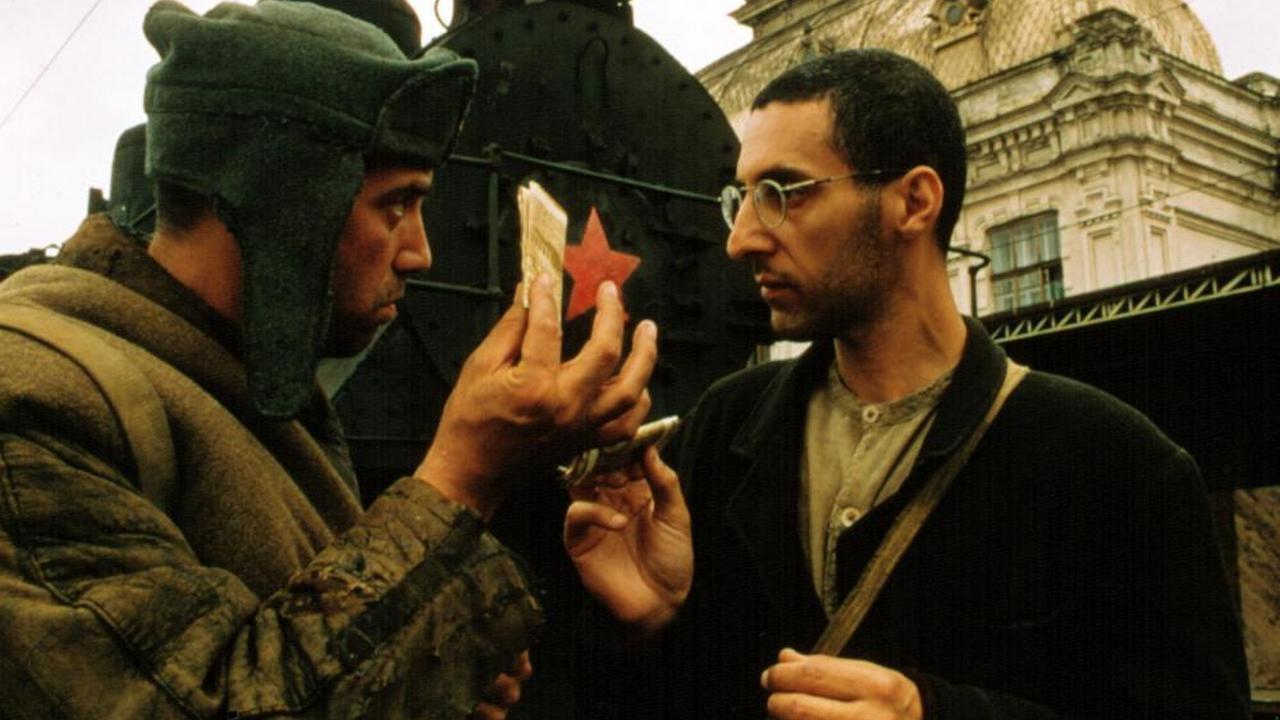
Based on the vital memoir by Italian writer and Holocaust survivor Primo Levi, The Truce (Italian title: La Tregua) picks up where his harrowing account If This Is a Man leaves off: the liberation of Auschwitz in January 1945. But liberation, as the film so powerfully illustrates, is not an endpoint. It's the beginning of another kind of trial – the long, bewildering, and often absurdly bureaucratic path back to something resembling home, back to a world irrevocably changed, carrying the ghosts of a place designed to extinguish humanity.
A Journey Through Limbo
This isn't a film driven by plot in the conventional sense, but by passage. We follow Primo Levi, embodied with extraordinary sensitivity by John Turturro, as he navigates the chaotic currents of displaced persons, shifting borders, and the sheer logistical nightmare of repatriation. His intended quick train ride from Poland back to Turin stretches into a months-long, circuitous trek through Belarus, Ukraine, Romania, Hungary, and Austria. Rosi, a master director known for his politically charged works like Salvatore Giuliano, doesn't shy away from the bleakness, but he crucially avoids exploitation. Instead, he paints a canvas of shared disorientation, capturing the strange camaraderie and fleeting moments of resilience that bloom even in desolate soil. The cinematography often feels muted, reflecting the drained emotional landscape, yet finds stark beauty in the sprawling, snow-dusted or war-scarred vistas.
Turturro's Quiet Witness
At the heart of it all is John Turturro. Known perhaps more widely for his vibrant, often eccentric character work (particularly with the Coen brothers), here he delivers a performance of profound restraint and internalized weight. His Levi is an observer, his eyes holding the quiet horror of what he's endured, but also a burgeoning curiosity about the strange tapestry of humanity unfolding around him. He's physically diminished but intellectually alert, processing the absurdity, the kindness, the lingering prejudices, and the sheer unpredictability of his fellow travelers. Turturro learned Italian for the role, and while much of the film uses dubbed voices common in Italian cinema of the era, his physical performance speaks volumes, conveying the burden of survival and the hesitant steps back towards feeling. It's a performance that feels deeply respectful to Levi's own measured, analytical, yet deeply human voice in his writing.
Encounters on the Road
Levi’s journey is punctuated by encounters with unforgettable characters, fellow survivors and wanderers caught in the same tide. Chief among them is Mordo Nahum, known as 'The Greek', played with magnetic, life-affirming energy by the great Croatian actor Rade Šerbedžija (viewers might recognise him from Snatch or Eyes Wide Shut). The Greek is a pragmatist, a charismatic operator navigating the chaos with a shrewd understanding of human nature and survival. His dynamic with the more introspective Levi forms one of the film's core relationships, a study in contrasting approaches to reclaiming life after trauma. Other figures drift in and out – Russian soldiers, fellow Italians, wary locals – each adding a brushstroke to this vast portrait of a continent in flux.
Rosi's Unflinching Gaze
Francesco Rosi had reportedly wanted to adapt Levi’s book for decades, and you can feel the weight of that long-held ambition in the film's deliberate pacing and thematic depth. This wasn't just another project; it felt like a duty. Adapting such seminal work is fraught with challenges. How do you visually represent the internal landscape Levi described so precisely in prose? Rosi focuses on the external journey as a mirror to the internal one. The seemingly nonsensical detours, the bureaucratic delays, the moments of unexpected connection – they all reflect the fractured, uncertain process of psychological healing, the difficulty of transitioning from the absolute horror of the Lager back to the 'normal' world.
Retro Fun Facts: The Long Road to Screen
- A Director's Dream: Rosi's passion for the project was immense. He saw Levi's book not just as a Holocaust story, but a universal tale of return and rediscovery after catastrophe. Securing the rights and funding for such a large-scale, multilingual European co-production took years.
- Shooting the Past: Finding locations that could convincingly double for the ravaged landscapes of 1945 was crucial. Much of the film was shot in Ukraine, leveraging its vast plains and older railway infrastructure to evoke the era. This involved complex logistics, especially filming extensive train sequences.
- Turturro's Immersion: Beyond learning Italian, Turturro spent time researching Levi's life and work, aiming to capture his specific blend of scientific detachment and deep empathy. It was a departure from his more outwardly expressive roles.
- Musical Resonance: The poignant score was composed by Luis Bacalov, who had won an Oscar just a couple of years earlier for Il Postino. His music subtly underscores the emotional journey without becoming intrusive.
- Festival Acclaim: The Truce competed for the prestigious Palme d'Or at the 1997 Cannes Film Festival, a testament to its artistic ambition and Rosi's standing in world cinema.
Beyond the Video Store Shelf
The Truce wasn't the kind of film you'd likely grab on a casual Friday night browse through Blockbuster back in '97, nestled between action blockbusters and romantic comedies. It demanded more attention, a willingness to engage with difficult history and complex emotions. Finding it on VHS perhaps felt like unearthing something significant, a piece of serious filmmaking that offered a different kind of cinematic experience. Watching it now, it feels less like a "90s movie" and more like a timeless reflection on the aftermath of atrocity and the enduring human need for connection and home. It asks us: how does one begin again after the unthinkable? What does it mean to truly return?
The film isn't perfect. The episodic nature occasionally leads to lulls, and the sheer scope means some supporting characters feel underdeveloped. Yet, its cumulative power is undeniable. It honours Levi's spirit by refusing easy answers or sentimentality, presenting the 'truce' not as peace, but as a fragile, uncertain interlude between the horror of the past and the challenge of the future.
Rating: 8/10
Justification: The Truce is a profoundly moving and intelligently crafted adaptation of essential source material. Francesco Rosi's direction is assured and sensitive, capturing the unique atmosphere of post-war limbo. John Turturro delivers a career-highlight performance of quiet depth, anchoring the film emotionally. While the pacing is deliberate and might test some viewers, the film's thematic resonance, historical importance, and the powerful humanity it finds amidst desolation make it a significant achievement. It doesn't flinch from darkness but ultimately affirms the resilience needed to step back into the light.
What lingers most is the quiet dignity of survival, the haunting question of how memory shapes us, and the realization that the journey home is often far longer and more complex than the miles traveled.