Okay, pull up a comfy chair, maybe grab a soda – remember those glass bottles? Let's talk about a film that flickered across CRT screens back in '93, one that maybe didn't burn as bright as others but left a distinct, somewhat unsettling afterimage: Money for Nothing. It poses that age-old barstool hypothetical, doesn't it? What would you do if a million bucks, literally, fell off a truck right in front of you? This film doesn't just ask the question; it dives headfirst into the messy, frantic, and ultimately tragic reality of one man who lived that fantasy, based on the true story of Joey Coyle.
An Offer You Can't Refuse?
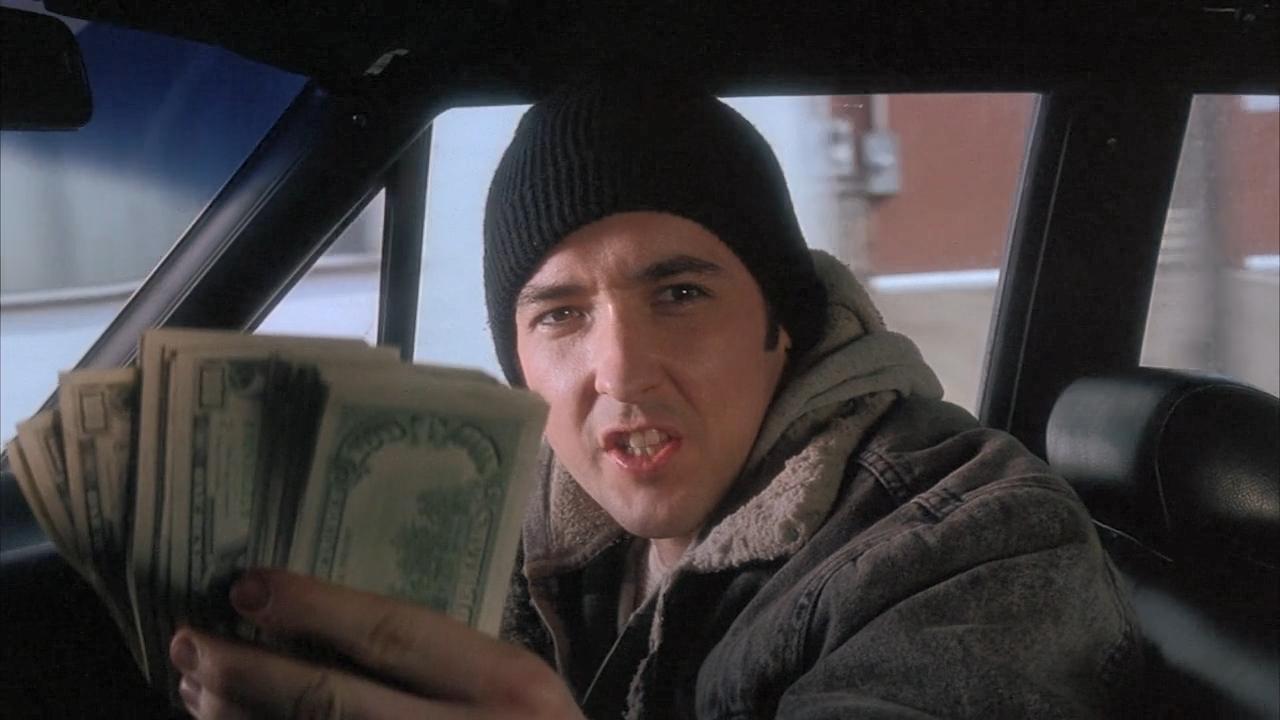
We meet Joey Coyle, played by John Cusack, an unemployed Philly longshoreman whose life feels stuck in neutral. He’s got charm, sure, but prospects? Not so much. Director Ramón Menéndez, who gave us the inspirational Stand and Deliver (1988), pivots here to something far bleaker. He paints a picture of early 90s working-class Philadelphia that feels authentic – the row houses, the neighborhood bars, the palpable sense of just getting by. Then, one drizzly afternoon, fate (or sheer random chance) throws a duffel bag containing $1.2 million in unmarked bills out of an armored truck and practically into Joey's lap. That single, almost surreal moment – the canvas bag tumbling onto the wet asphalt – kicks off a spiral of bad decisions fueled by desperation and intoxicating greed. It's the ultimate get-rich-quick scheme, dropped from the sky, but as we watch Joey scramble, the question shifts from "What would you do?" to "What shouldn't you do?"
Cusack's Gamble
This film arrived at an interesting point for John Cusack. Many of us still saw him as the thoughtful, slightly quirky romantic lead from films like Say Anything... (1989). Here, he sheds that persona completely. His Joey Coyle is jittery, impulsive, and increasingly paranoid. Cusack throws himself into the role, capturing the initial giddy excitement that quickly curdles into frantic fear. You see the weight of the situation crushing him, the impossibility of normalcy returning. It’s not always a comfortable performance to watch; Joey makes frustrating, obviously terrible choices, shouting at the screen territory. Yet, Cusack makes his panic feel real, his descent believable even when his actions are baffling. It’s a committed turn that anchors the film, showing an actor eager to explore darker, less conventional territory. Was it a gamble that fully paid off? Perhaps not commercially, but it certainly demonstrated his range.
Gritty Streets and Familiar Faces
Supporting Cusack is a solid ensemble cast familiar to any 90s film buff. Debi Mazar, instantly recognizable from her sharp turns in films like Goodfellas (1990), plays Joey’s pragmatic girlfriend, Monica. She serves as a kind of moral compass, increasingly alarmed by Joey's erratic behavior, representing the life he’s throwing away. And then there’s Michael Madsen, fresh off his terrifyingly cool Mr. Blonde in Reservoir Dogs (1992), stepping into the role of Detective Pat Laurenzi. Madsen brings his trademark quiet menace, the weary cop who knows this kind of easy money never ends well. The film benefits hugely from its Philadelphia setting, shot on location, giving it a texture and realism that elevates the material beyond a simple crime story. Menéndez captures the specific mood of the city, making it almost another character in Joey’s unfolding drama.
The Weight of Reality (Retro Fun Facts)
Knowing the true story behind Money for Nothing adds a layer of melancholy. Joey Coyle really did find that money in 1981, leading to a chaotic week trying to launder it before eventually being caught. The film sticks relatively close to the known events, highlighting the sheer amateurishness of his attempts to handle the windfall. Sadly, the real Joey Coyle took his own life in August 1993, just weeks before the film's premiere, adding a tragic resonance that the filmmakers couldn't have foreseen during production.
It’s also interesting to note this was a significant directorial shift for Ramón Menéndez after the critical success of Stand and Deliver. Money for Nothing, budgeted at roughly $11 million (around $23.5 million today), unfortunately, didn't find its audience, grossing only about $1 million domestically. It quietly slipped onto video store shelves, becoming one of those "Oh yeah, I think I remember that one" titles for many. Perhaps its cautionary tone, lacking a truly triumphant or redemptive arc, was a tougher sell back then. The initial critical reception was lukewarm at best; it didn't quite ignite the conversation its compelling premise deserved. Watching it now, though, removed from the box office pressures, allows for a different appreciation of its gritty realism and Cusack’s performance.
A Cautionary Tale Revisited
So, what lingers after the tape clicks off? Money for Nothing isn't a perfect film. Its pacing sometimes flags, and Joey’s relentless streak of bad choices can test viewer patience. But it succeeds as a grounded, often tense look at how sudden, unearned fortune can be more curse than blessing. It explores themes of temptation, the corrosive nature of greed, and the desperation that can push ordinary people to extraordinary folly. It doesn't offer easy answers or a feel-good resolution, much like the true story it’s based on. Doesn't that unflinching quality give it a certain power, even now? It serves as a stark reminder that sometimes the greatest fortune is the life you already have, imperfections and all.
Rating: 7/10
This score reflects a film that, while flawed and perhaps overlooked, boasts a compelling true story, a committed central performance from John Cusack playing against type, and an effectively gritty atmosphere. Its commercial failure and sometimes frustrating narrative keep it from reaching classic status, but it’s a solid piece of 90s crime drama that offers more depth than you might initially expect.
It’s a fascinating time capsule of early 90s anxieties and a potent reminder that finding a fortune doesn't always mean finding happiness. Sometimes, it just means finding a whole lot more trouble. Worth digging out of the archives if you spot that worn VHS cover.