Okay, settle back into that worn armchair, maybe imagine the faint hum of a CRT nearby. Today, we're digging out something a little different from the usual blockbuster fare, a short but potent piece of animation that punched well above its weight class back in 1989: Christoph Lauenstein and Wolfgang Lauenstein's stark masterpiece, Balance. You might not have rented this one specifically – it wasn't exactly vying for shelf space next to Batman or Indiana Jones and the Last Crusade – but perhaps you caught it during an animation festival on late-night TV, or maybe it was a surprising inclusion on a curated VHS compilation. Regardless of how you first encountered it, its imagery likely lingered.
### A Precarious Platform in the Void
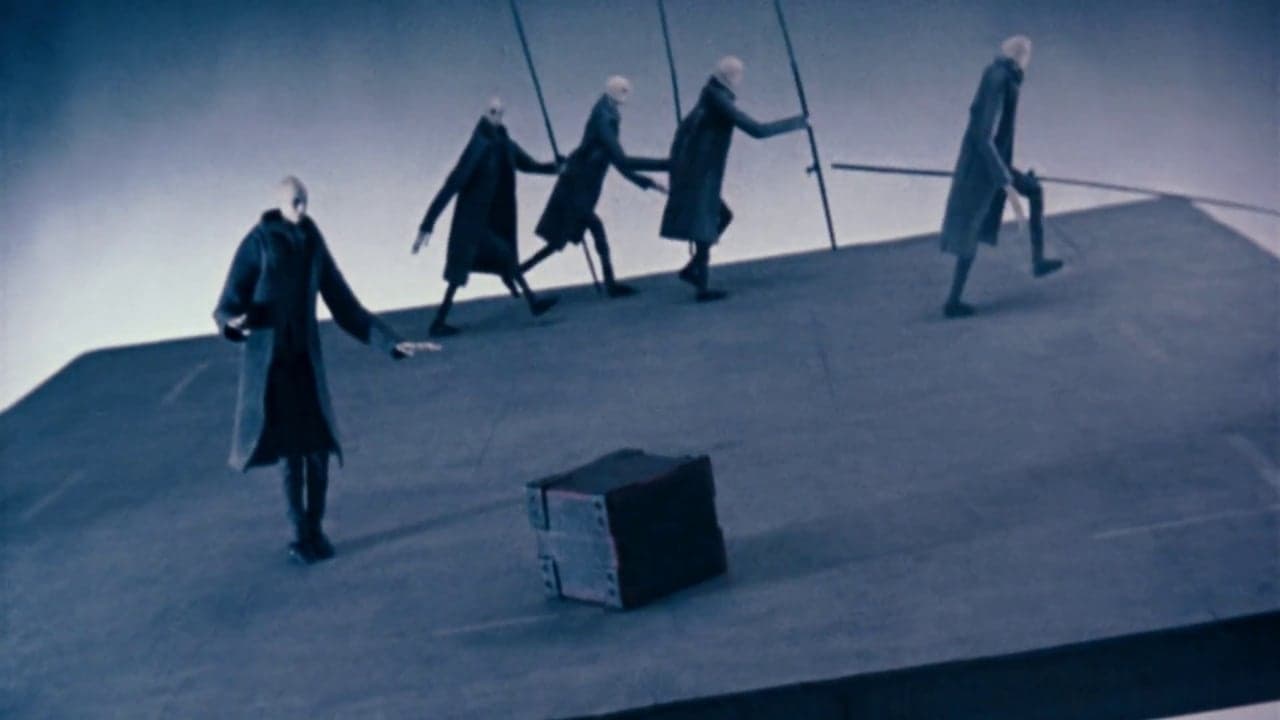
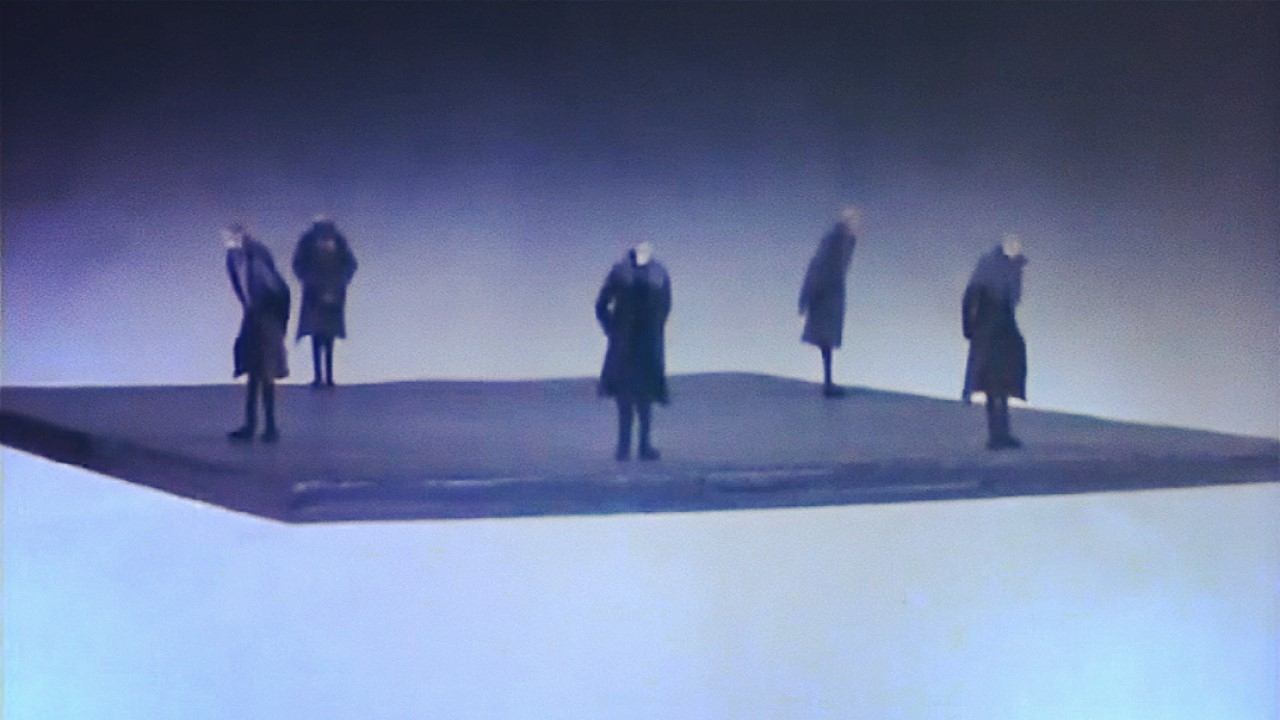
The film opens onto an image of stark simplicity, yet immediate unease. Five identical, gaunt figures stand upon a flat, square platform suspended in an infinite, grey void. They are dressed in identical long coats, their faces angular and mostly featureless, distinguished only by numbers on their backs. The platform tilts precariously with every shift in weight. Their existence is defined by a single, overriding imperative: maintaining equilibrium. It's a constant, silent negotiation, a delicate dance where one wrong move could send them all tumbling into the abyss. This central visual metaphor is the film's engine, and it's astonishingly effective.
### The Weight of Desire
The initial state is one of wary cooperation. The figures understand the physics of their world; they counterbalance each other, moving with deliberate care. The tension is palpable even in these early moments. Then, something changes. One figure, fishing over the edge of the platform, reels in a mysterious, heavy box. Curiosity – or perhaps greed? – ripples through the small community. The box becomes a focal point, an object of desire that disrupts the established order. Suddenly, the careful choreography breaks down. The figures jockey for position, trying to get closer to the intriguing object, forgetting the fundamental rule of their shared existence. What does this box represent? Wealth? Knowledge? Power? The film wisely leaves it ambiguous, allowing the symbol to resonate on multiple levels. Doesn't this struggle feel unnervingly familiar, reflecting the precarious balances we navigate in our own societies, relationships, and even within ourselves?
### Masterclass in Minimalist Storytelling
What makes Balance so powerful is its economy. In under eight minutes, with no dialogue whatsoever, the Lauenstein brothers craft a complete and devastating narrative arc. The stop-motion animation is meticulous, giving the figures a jerky, slightly unsettling quality that enhances the mood. Their movements, though simple, convey a surprising range of intent – caution, curiosity, suspicion, selfishness, and ultimately, despair. The stark, minimalist design focuses all attention on the characters and their relationship to the platform and the box. There are no distractions, just the raw mechanics of cause and effect. The sound design is equally spare, emphasizing the creaks of the platform and the thud of the box, amplifying the tension. It’s a testament to the power of visual storytelling, proving that complex ideas don't always require elaborate exposition. Remember seeing stop-motion like this back then? It had a tangible, handmade quality that CGI often lacks, a feeling that real objects were being painstakingly brought to life.
### Echoes of the Era and Enduring Questions
Released in 1989, the year the Berlin Wall fell, it’s tempting to read Balance through the lens of Cold War politics – a commentary on the precarious standoff between superpowers, where one side's gain inevitably destabilizes the whole system. The Lauenstein brothers, being German filmmakers, were certainly immersed in that context. Indeed, the film deservedly won the Academy Award for Best Animated Short Film that year, a recognition of its potent allegory and technical skill. It’s a fascinating bit of trivia that such a seemingly simple, almost abstract piece captured the attention of the Academy amidst potentially more crowd-pleasing animated fare. The production itself was reportedly a patient, meticulous process, characteristic of independent stop-motion projects where passion often outweighs budget.
Yet, the film’s themes transcend any single political interpretation. It speaks to resource scarcity, the dangers of unchecked desire, the breakdown of cooperation, and the isolation that results from prioritizing individual gain over collective well-being. The final image (Spoiler Alert!) – one figure trapped, forever forced to counterbalance the coveted box while the others are lost to the void – is haunting and unforgettable. It leaves you pondering: was the prize worth the cost? What happens when the delicate systems we rely on are thrown out of kilter by greed or shortsightedness?
***
Rating: 9/10
Balance earns this high mark for its sheer conceptual brilliance, masterful execution within its minimalist framework, and enduring thematic resonance. It achieves more emotional and intellectual depth in under eight minutes than many feature-length films. The stop-motion animation is superb, the atmosphere is thick with tension, and its central metaphor is both simple and profound. It might lack the rewatchable fun factor of some VHS favorites, preventing a perfect score, but its artistic impact is undeniable.
It’s a stark reminder, delivered with chilling precision, that our actions have consequences, often extending far beyond ourselves. A true gem of late 80s animation, Balance is one short film that forces you to confront the weight of your own choices long after the screen goes dark.