## Beyond Pleasure, Beyond Pain: Reflecting on Shūji Terayama's "Fruits of Passion"

Some films arrive not as entertainment, but as challenges. They lodge themselves under your skin, demanding contemplation long after the VCR has clicked off and the screen has faded to grey static. Shūji Terayama’s 1981 venture, Fruits of Passion (Les Fruits de la passion), is undeniably one such film – a disorienting, often disturbing, yet strangely beautiful plunge into the labyrinthine corridors of desire, power, and submission. Finding this tape nestled perhaps in the 'Foreign' or, let's be honest, sometimes the curtained-off 'Adult' section of the video store back in the day was a signal: this wasn't going to be your typical Friday night rental.
An Unsettling Proposition
Loosely spinning off from the notorious sequel to Story of O, the film transports the core dynamic to a surreal, meticulously crafted vision of early 20th-century colonial Hong Kong (though largely filmed with striking theatricality in Japan). The premise is stark: the enigmatic Sir Stephen, portrayed with a chilling intensity only Klaus Kinski could muster, delivers his lover, O (Isabelle Illiers), to an opulent, high-class brothel run by the elegant Madame (Arielle Dombasle). His goal? To test the absolute limits of her devotion and submission through systematic degradation within this gilded cage. It’s a setup ripe for exploitation, yet in Terayama’s hands, it becomes something far stranger and more complex.

Terayama's Theatre of Cruelty
Forget a straightforward narrative adaptation. Shūji Terayama, a radical poet, playwright, and filmmaker steeped in the Japanese avant-garde (co-founder of the influential Tenjō Sajiki theatre group), uses the source material as merely a starting point for his own distinct, often phantasmagorical vision. The film unfolds less like a story and more like a series of elaborate, sometimes baffling, tableaux vivants. Terayama fills the screen with potent, recurring symbols – clocks ticking relentlessly, cages both literal and metaphorical, masks obscuring identity, water reflecting distorted realities. The production design is exquisite, creating a claustrophobic, hyper-stylized world that feels deliberately artificial, heightening the sense of ritual and performance inherent in the characters' interactions. This isn't realism; it's a fever dream rendered on celluloid, a translation of psychological states into potent visual poetry. Terayama wasn't just filming a script; he was orchestrating a visual and thematic opera of extremes.
Performances Under an Unblinking Gaze
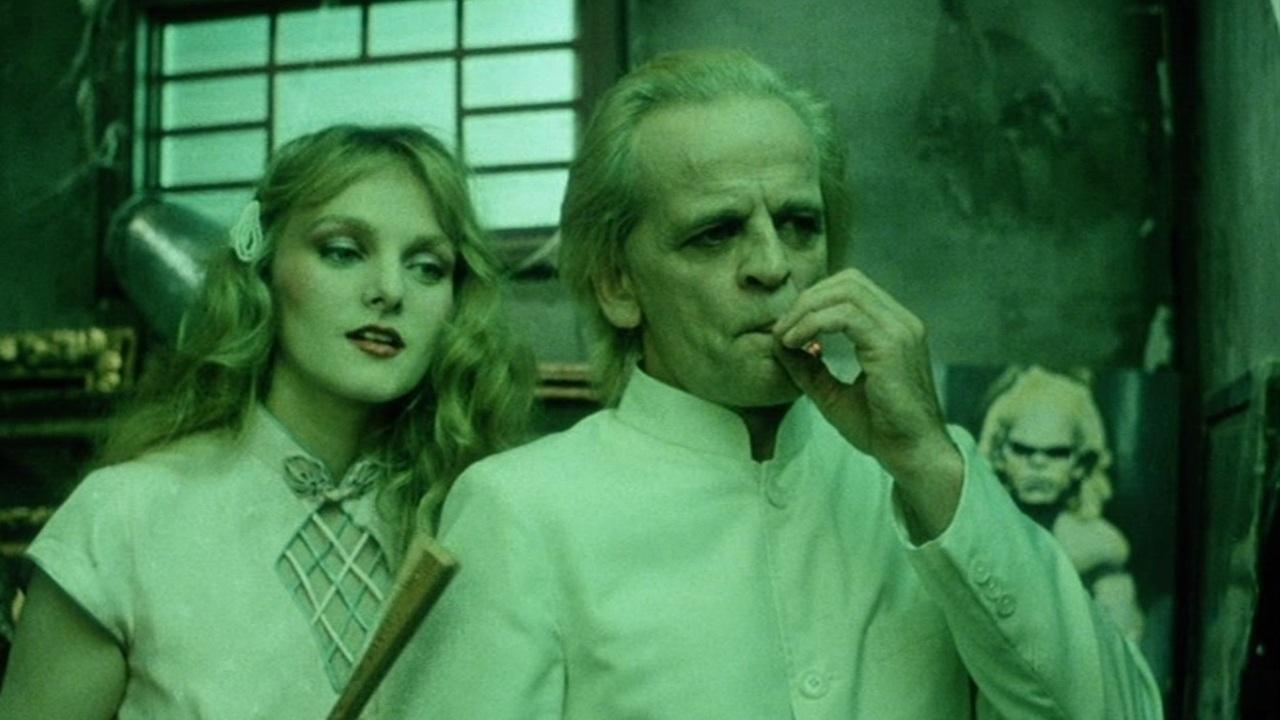

At the heart of this unsettling spectacle lies Klaus Kinski. Even by his own volatile standards, his Sir Stephen is a figure of terrifying control. Kinski doesn't just act; he radiates a palpable aura of intellectual cruelty and detached possession. Knowing his notorious reputation for clashing with directors (and Terayama was reportedly no exception, leading to palpable tension on set), one almost wonders if some of that real-life friction bled onto the screen, amplifying the character's menace. Yet, there's a precision to his performance, a coiled stillness that makes the character all the more unnerving.
Counterbalancing him is Isabelle Illiers as O. It's a tremendously difficult role, demanding vulnerability and resilience in the face of relentless objectification. Illiers conveys O’s journey – or perhaps descent – largely through her physicality and expressive eyes. Is it acceptance? Resignation? Or a complex internal negotiation hidden beneath the surface of submission? The film leaves these questions deliberately ambiguous, forcing the viewer to grapple with O’s experience. Arielle Dombasle, known for her work with Éric Rohmer, brings a cool, knowing elegance to the Madame, another figure wielding power within this tightly controlled environment.
Navigating Difficult Waters
Fruits of Passion is undeniably confrontational. It forces viewers to confront uncomfortable themes: the intoxicating and destructive nature of absolute power, the ambiguities of consent in extreme scenarios, the objectification inherent in certain power dynamics, and the exoticism layered onto the colonial setting. Terayama’s surreal approach complicates easy interpretations. Is the film merely replicating the exploitation it depicts, or is it a critique delivered through an unsettling aesthetic lens? Does the sheer artistry of the presentation excuse or even elevate the disturbing subject matter? These aren't easy questions, and the film offers no simple answers. Watching it feels less like passive consumption and more like an active engagement with challenging, potentially problematic material. What does O's ultimate fate truly signify about the nature of identity when stripped bare?
A Controversial Artifact of the VHS Era
This film was never destined for mainstream success. A French-Japanese co-production tackling incendiary themes through an avant-garde style, it inevitably polarized critics and audiences upon release. Finding it on VHS was like unearthing a rare, possibly dangerous, artifact. It wasn't Debbie Does Dallas, nor was it a straightforward European art film. It occupied a strange, liminal space – too arty for the raincoat crowd, too explicit and potentially exploitative for some cinephiles. Yet, for adventurous viewers seeking cinema that pushed boundaries, Fruits of Passion offered an unforgettable, if deeply troubling, experience. It’s a potent reminder of a time when video stores could offer access to the truly transgressive corners of world cinema, challenging viewers far beyond the multiplex fare.

Rating: 6/10
This rating reflects the film's undeniable artistic ambition and Shūji Terayama's unique, challenging vision. The cinematography, production design, and Klaus Kinski's commanding performance are powerful draws. However, the deeply unsettling subject matter, the deliberately alienating style, and the ethical ambiguities surrounding its portrayal of submission make it a difficult, demanding, and frankly, not enjoyable watch in the conventional sense. It earns points for its audacity and artistic integrity, but loses them for its potentially exploitative elements and its sheer capacity to disturb rather than enlighten for some viewers. It's a film easier to admire for its craft and provocation than to embrace.
Fruits of Passion lingers not as a fond memory, but as a haunting question mark – a testament to a filmmaker daring to explore the darkest aspects of human desire, leaving the viewer adrift in its beautiful, terrifying, and morally ambiguous world. It's a challenging relic from the VHS shelves, best approached with caution and an open, critical mind.