There’s a certain kind of quiet dread that settles in your stomach when watching Nick Broomfield’s Kurt & Courtney. Released in 1998, just four years after the gunshot that silenced a generation’s voice, the film doesn’t offer easy answers or comforting closure. Instead, it throws you headfirst into a murky, unsettling pool of grief, accusation, and the kind of raw, unresolved anguish that clings to the air long after the credits roll. Picking up this tape back in the day felt almost illicit, like peering into something intensely private and deeply troubled.
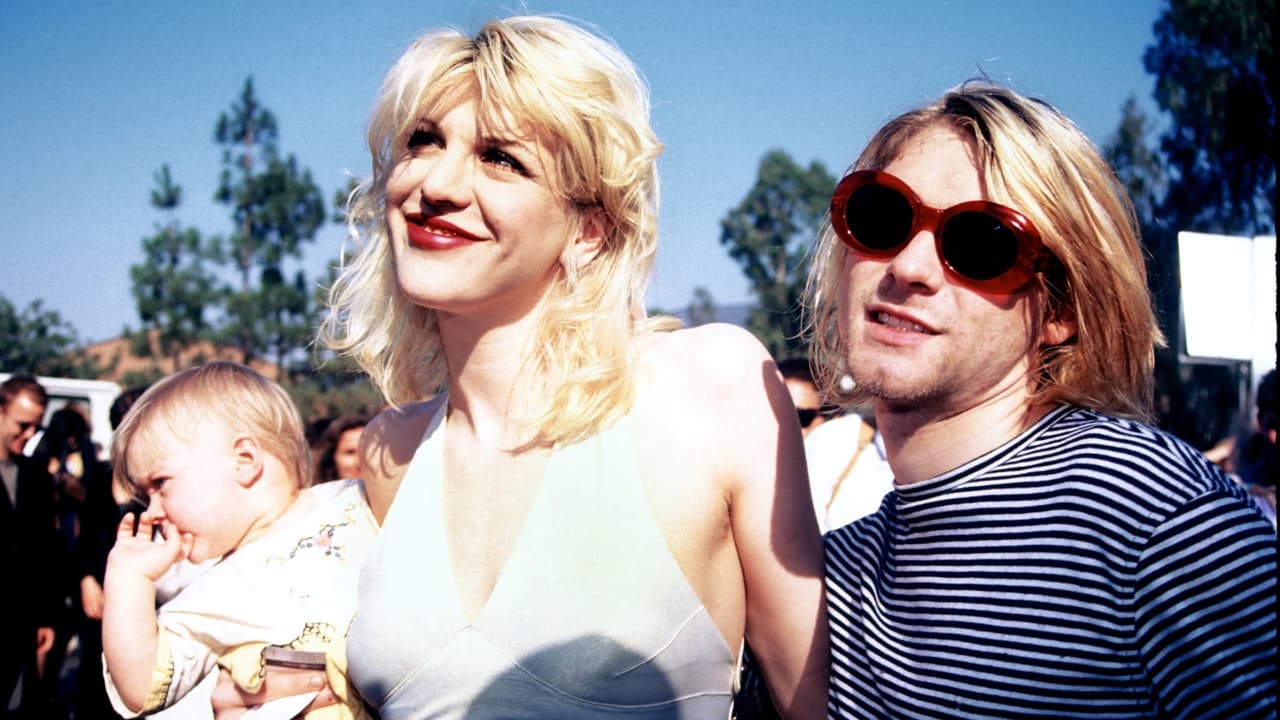
Into the Maelstrom with Broomfield
Nick Broomfield, known then for his immersive, often confrontational documentary style seen in works like Heidi Fleiss: Hollywood Madam (1995), doesn’t position himself as an objective observer here. He’s the slightly rumpled, boom-mic-wielding protagonist of his own investigation, navigating a landscape populated by peripheral figures, estranged relatives, and conspiracy theorists, all orbiting the twin stars of Kurt Cobain and Courtney Love. His approach often feels less like precise journalism and more like persistently rattling cages, hoping something vital, or at least revealing, falls out. It’s a style that can be frustrating – sometimes feeling scattershot or opportunistic – yet it undeniably mirrors the chaotic, often contradictory narratives surrounding Cobain's final days. You’re right there with him, feeling the awkwardness of interviews, the dead ends, the sudden, chilling turns.
Chasing Shadows and Whispers
The film largely hinges on the controversial theory that Cobain's death was not a suicide, but a homicide potentially orchestrated or covered up by Courtney Love. Broomfield pursues this thread relentlessly, interviewing key proponents like Tom Grant, the private investigator Love herself hired shortly before Cobain's death, who meticulously lays out his case file’s perceived inconsistencies. We also meet Cobain's estranged Aunt Mary, who voices her doubts, and perhaps most notoriously, Eldon "El Duce" Hoke, the volatile frontman of shock-rock band The Mentors.
El Duce’s segment remains one of the most disturbing and infamous parts of the film. Claiming Love offered him $50,000 to kill Cobain, his slurred, often incoherent testimony is hard to parse, let alone trust. Yet, the sequence gains a horrifying resonance from the fact that El Duce himself died in mysterious circumstances (hit by a train) just days after filming his interview. Broomfield doesn’t shy away from the grim irony, letting the event hang heavy in the narrative, adding another layer to the film's pervasive sense of darkness and unanswered questions. It's a stark reminder of the very real stakes, even amidst the noise and speculation.
The Spectre of Courtney
Courtney Love looms large over the film, despite her refusal to be formally interviewed. Her presence is felt through archival footage, the accounts of others, and crucially, through her active efforts to hinder the film's production and distribution. A fascinating subplot involves Love leveraging her influence, reportedly pressuring MTV and others to pull support, and attempting to block the use of Nirvana's music. This led to a famous confrontation at the ACLU Freedom of Speech Awards, where Broomfield publicly challenged Love (who was receiving an award) about censorship – a moment that underscored the film's contentious journey. Does her resistance prove guilt, as some interviewees suggest? Or is it the understandable reaction of a grieving widow hounded by conspiracy theories during an intensely vulnerable period? The film doesn't – perhaps can't – definitively say, leaving the viewer suspended in that ambiguity.
A Raw Reflection of its Time
Watching Kurt & Courtney today, it feels very much a product of the late 90s – the grainy footage, the raw immediacy, the pre-internet deep-dive feel of the investigation. It captures a specific moment when the shock of Cobain’s death was still palpable, and the hunger for answers – any answers – was intense. I remember renting this from Blockbuster, the stark black and white cover art promising something gritty and revealing. It didn't disappoint on the 'gritty', but 'revealing' remained elusive. It wasn't a polished piece; it felt messy, complicated, much like the lives it was examining. Interestingly, Broomfield has stated his initial aim was a film celebrating Cobain's life and music, but the project morphed dramatically as he encountered the persistent rumors and Grant's investigation. This shift in focus became the story.
The film's low budget (reportedly around $200,000-$300,000) is evident in its aesthetic, but this arguably works in its favor, lending it an unvarnished, almost cinéma vérité quality that enhances the feeling of being embedded in a difficult, unfolding situation.
Lingering Questions, Faded Tape
Does Kurt & Courtney solve the mystery? Absolutely not. It doesn't possess the smoking gun or the definitive proof that figures like Tom Grant believe exists. What it does achieve is a powerful, albeit biased, portrait of the swirling chaos, grief, and suspicion surrounding a cultural icon's tragic end. It forces us to confront the uncomfortable relationship between celebrity, media narratives, and the often-unseen human cost. It asks difficult questions about who gets to tell whose story, and how easily truth can become obscured by noise and agenda.
Rating: 7/10
The score reflects the film's undeniable power as a compelling, if deeply flawed and one-sided, documentary. Nick Broomfield's relentless, personal style makes for captivating viewing, and the film captures a specific, raw moment in post-Cobain pop culture history. Its inclusion of the El Duce interview and the documentation of Courtney Love's attempts to suppress the film add layers of genuine intrigue and controversy. However, its lack of balance, reliance on sometimes questionable sources, and ultimate inability to provide concrete answers prevent it from being a definitive piece of investigative journalism. It succeeds more as a provocation, a snapshot of suspicion, than as an exposé.
Ultimately, Kurt & Courtney remains a potent artifact from the VHS era – a difficult, unsettling watch that leaves you pondering not just the specific tragedy of Kurt Cobain, but the very nature of truth in the shadow of fame and loss. What lingers most isn't certainty, but the profound, echoing silence where answers ought to be.