Here we go, fellow tape travellers, let's rewind to a time when sci-fi on the small screen was starting to dream bigger, reaching for complex narratives beyond the monster-of-the-week. In 1993, something ambitious flickered onto our CRT screens, often via the slightly fuzzy signal of syndicated networks like PTEN. It wasn't just another star trek; it was the beginning of a sprawling saga: J. Michael Straczynski's bold experiment, Babylon 5: The Gathering. Finding this pilot movie on a Blockbuster shelf felt like uncovering a secret transmission, a glimpse into a universe teeming with political intrigue and ancient mysteries.
### A Beacon in the Dark
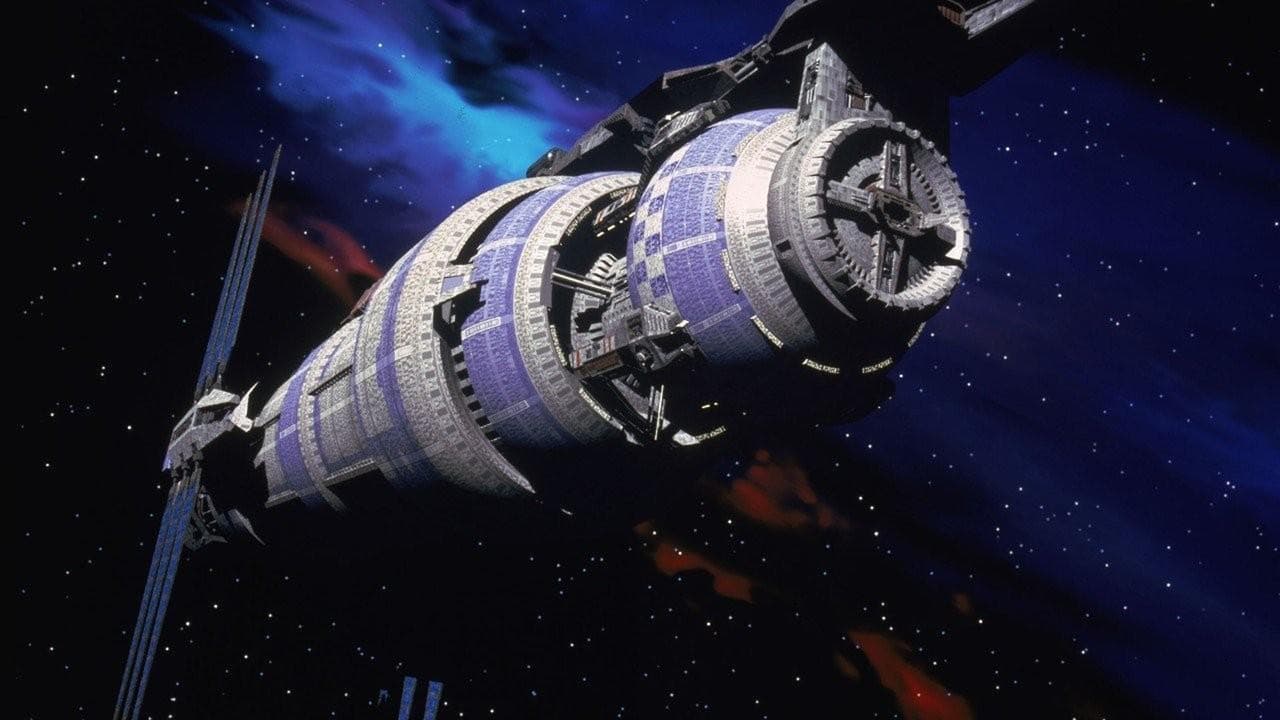
Forget pristine Federation starships for a moment. The Gathering throws us headfirst into the controlled chaos of Babylon 5, a five-mile-long diplomatic outpost parked in neutral space. Its mission, as Commander Jeffrey Sinclair (Michael O'Hare) reminds us, is noble: a last, best hope for peace where humans and aliens can hash out their differences without vaporizing each other. This wasn't just space opera; it felt like the UN Security Council relocated to the final frontier, complete with simmering resentments and fragile alliances. The pilot wastes no time establishing this pressure-cooker atmosphere, centered around the arrival of the enigmatic Vorlon Ambassador Kosh Naranek and the subsequent assassination attempt that threatens to shatter the station's delicate purpose.
### First Impressions and Future Faces

Watching The Gathering now is fascinating, partly because it’s like looking at an early blueprint. Michael O'Hare brings a weary gravitas to Sinclair, a commander haunted by his past (specifically, a gap in his memory during the Earth-Minbari War – a crucial plot thread the series would later explore). Alongside him is the capable but somewhat stern Lt. Commander Laurel Takashima, played by Tamlyn Tomita. While Takashima wouldn’t continue into the main series (replaced by Claudia Christian's iconic Susan Ivanova), her presence here provides a different dynamic. And then there's Jerry Doyle as Michael Garibaldi, the wise-cracking Chief of Security who immediately feels like the grounded, relatable heart of the station – a role Doyle would embody perfectly for years. We also get our first tantalizing glimpses of Ambassadors G'Kar and Londo Mollari, whose complex relationship would become one of the series' defining pillars. The performances occasionally feel a little stiff, as is common in pilots finding their footing, but the potential is palpable.
### Building Worlds on a Budget
You have to admire the sheer ambition J. Michael Straczynski (JMS) poured into this. Known for meticulously planning his narratives years in advance – a rarity for television then (and even now!) – The Gathering lays down track for storylines that wouldn't pay off for seasons. This pilot had the unenviable task of introducing a complex world, multiple alien races (Minbari, Narn, Centauri, Vorlons!), intricate political backstories, and a central mystery, all while trying to hook network executives and audiences. Produced for the nascent Prime Time Entertainment Network (PTEN), a bold attempt at a fifth broadcast network, the budget constraints are sometimes visible. The CGI, while groundbreaking for television syndication in 1993, looks understandably dated now, though the design of the station itself remains iconic. One particularly interesting behind-the-scenes note is the original score by Stewart Copeland, drummer for the legendary band The Police. His atmospheric, sometimes quirky electronic themes gave The Gathering a distinct feel, quite different from the more orchestral, sweeping score Christopher Franke (formerly of Tangerine Dream) would later compose for the series proper. JMS himself later re-edited the pilot in 1998 into a "Special Edition", tweaking scenes and replacing Copeland's score entirely with Franke's music to better align it with the series' tone – a fascinating example of a creator revisiting their work. Finding the original VHS often meant experiencing Copeland’s unique take.
### More Than Just Pew-Pew
What really set Babylon 5 apart, even in this early stage, was its focus. While there's action and mystery surrounding the assassination plot, the real drama unfolds in dialogue, in diplomatic maneuvering, in the clash of cultures and ideologies. It tackled themes of prejudice, political expediency, and the burden of history with a maturity often absent from its contemporaries. Remember the palpable tension when the Minbari delegation arrives, given their recent war with Earth? Or the veiled threats exchanged between G'Kar and Londo? This was sci-fi that asked you to think, to piece together the puzzle alongside the characters. It promised a story that respected its audience's intelligence. It wasn't just about exploring strange new worlds; it was about understanding the complexities within ourselves and our societies, mirrored in the vastness of space.
### The Pilot's Legacy
As a standalone TV movie, The Gathering is perhaps a little uneven. The pacing occasionally drags, some effects creak, and certain character dynamics hadn't quite solidified. But its importance cannot be overstated. It successfully pitched JMS's grand vision, convincing PTEN to greenlight the full series that would become a landmark of serialized television drama, influencing countless shows that followed. It dared to be different, weaving a complex tapestry when episodic adventures were the norm. Watching it on VHS back in the day, perhaps recorded off that slightly snowy syndicated channel, felt like being let in on the ground floor of something special, something that was going to grow into an epic. It was a promise of wonders to come.
---
VHS Heaven Rating: 7/10
Justification: While rough around the edges compared to the polished series it spawned, Babylon 5: The Gathering is a remarkably ambitious and intelligent pilot. It successfully establishes a rich universe, introduces compelling core concepts, and hints at the epic narrative depth to come. Points are deducted for some stiffness in execution, dated effects (even for the era, compared to film), and pacing issues inherent in setting up such a complex world. However, its foundational importance, JMS's clear vision, and the sheer novelty of its approach in 1993 earn it a solid score.
Final Thought: Like finding a rare first edition, The Gathering on tape is a tangible piece of sci-fi history – a slightly imperfect, utterly fascinating portal back to the dawn of a truly groundbreaking television journey. It reminds us that sometimes, the greatest adventures begin not with a bang, but with a handshake… or an assassination attempt.