## A Chain-Smoking Prophet in the Static: Revisiting Bill Hicks: Relentless (1992)
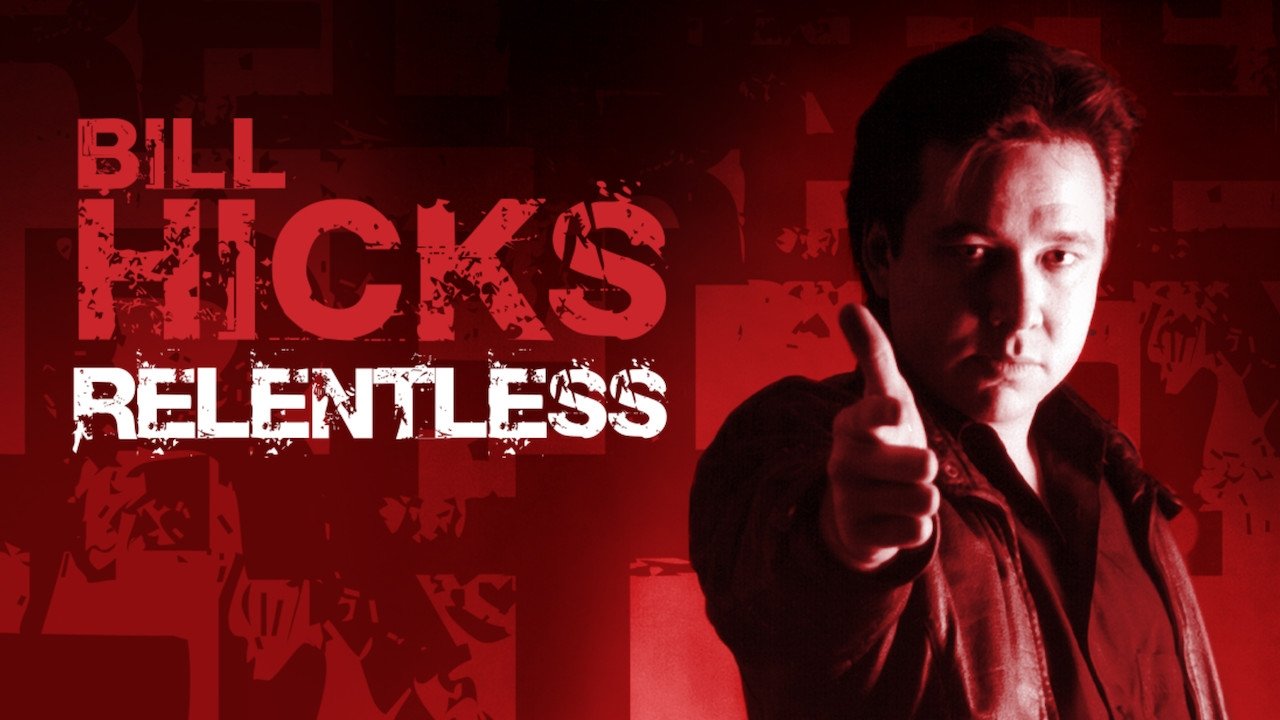
There's a certain kind of static cling that comes with memories of specific VHS tapes. For me, the well-worn copy of Bill Hicks: Relentless, recorded off late-night TV or perhaps a dubious rental duplicate, carried an almost electric charge. It wasn't just another stand-up special sandwiched between action flicks and sitcom reruns. Sliding it into the VCR felt like tuning into a forbidden frequency, a broadcast from the angry, fiercely intelligent heart of a culture seemingly determined to anaesthetize itself. Even now, watching it again, that initial jolt remains – the feeling of encountering something raw, unfiltered, and unsettlingly necessary.
Filmed at the prestigious Just for Laughs festival in Montreal, Relentless captures Bill Hicks at a searing peak. Forget the easy observational humor that dominated much of early 90s comedy; Hicks wasn't there to merely point out life's little absurdities. He was on stage, prowling, chain-smoking, armed with a microphone and a scalpel, ready to dissect the rotting carcass of consumerism, media manipulation, and political hypocrisy he saw all around him. The title wasn't just a hook; it was a mission statement.
Truth, Anger, and the Laughs In Between

What strikes you immediately about Hicks' performance, expertly captured by director Chris Bould with a focus that rightly keeps the comedian front and center, is its sheer authenticity. This wasn't an act merely put on for the stage; you felt the genuine frustration simmering beneath every perfectly timed pause, every sudden explosion of righteous fury. He paced the stage like a caged preacher, cigarette constantly in hand – a visual punctuation mark to his relentless points. Was it anger? Absolutely. But it was anger rooted in a profound disappointment, a yearning for humanity to be better, smarter, less easily led.
His targets were, and often remain, depressingly relevant. He tore into advertising ("You are Satan's spawn filling the world with bile and garbage"), the vapidity of mainstream pop culture, the blind obedience demanded by governments, and the often-hypocritical stances of organized religion. His infamous routines about the Gulf War or his deconstruction of anti-drug hysteria weren't just jokes; they were polemics wrapped in punchlines. You laughed, sometimes uncomfortably, because the truth in his observations hit too close to home. Does anyone else remember the sharp intake of breath in the room (or just in your own living room) when he’d land a particularly brutal point?
Beyond the Rant: A Mind at Work
It would be easy to dismiss Hicks as merely an angry ranter, but that misses the sharp intellect driving the performance. He wasn't just shouting into the void; he was constructing arguments, using dark humor and shocking imagery to force his audience to think. His routines often spiralled into philosophical territory, questioning the nature of reality, consciousness, and our place in the universe – particularly evident in his passionate, often controversial, defenses of psychedelic experiences as tools for perception expansion. This wasn't comedy designed solely for easy consumption; it demanded engagement.
The simplicity of the production serves the material perfectly. No flashy graphics, no elaborate sets – just Hicks, a microphone, a stool he rarely used, and the rapt audience at Montreal's Centaur Theatre. It feels intimate, almost conspiratorial, like you're privy to a secret meeting where uncomfortable truths are finally being spoken aloud. It’s a stark contrast to the hyper-produced specials common today, and that raw quality feels intrinsically part of the message.
Retro Fun Facts & Lingering Echoes
Thinking back, Relentless felt like a significant marker in the rise of "alternative" comedy finding a broader audience, especially outside the US. While Hicks certainly had his American following, his unflinching critiques often met with resistance or confusion stateside (culminating infamously in his censored final Letterman appearance shortly before his death). Yet, particularly in the UK, he was embraced as a vital, prophetic voice. Relentless and his subsequent UK-filmed special, Revelations (1993), cemented his legendary status there.
It's impossible to watch Relentless now without the tragic context of Hicks' death from pancreatic cancer in early 1994, less than two years after this performance. Suddenly, the urgency in his voice, the feeling that he had to get these ideas out, takes on an almost unbearable poignancy. The relentless energy feels finite, precious. It adds another layer to routines like his closing piece about life being "just a ride," urging perspective and love over fear. Knowing his own ride was nearing its end makes the message land with devastating impact. He left behind a relatively small body of officially released work – Sane Man (1989) being the other major special from this era – making Relentless an essential document.
The Verdict
Relentless isn't comfortable viewing. It challenges, it provokes, it might even offend. But it is also brilliantly funny, breathtakingly intelligent, and powered by a singular voice that refused to compromise. Bill Hicks holds the stage with an intensity few comedians before or since have matched. His targets remain stubbornly relevant, and his call to question everything feels more urgent than ever in our own noisy, often nonsensical times. Watching it on that grainy VHS tape felt like finding a crack in the wall of manufactured reality; revisiting it now confirms its power hasn't diminished one bit. It's a vital piece of comedy history, a time capsule of righteous anger and startling insight.
Rating: 9/10
Justification: This rating reflects the sheer power and authenticity of Hicks' performance, the enduring relevance and intelligence of his material, and its status as a landmark special in alternative comedy. While its confrontational nature might not be for everyone, its impact and artistry are undeniable. The slight deduction acknowledges that the pure "laugh-a-minute" ratio might be lower than some expect from a comedy special, as it prioritizes message and provocation alongside humor.