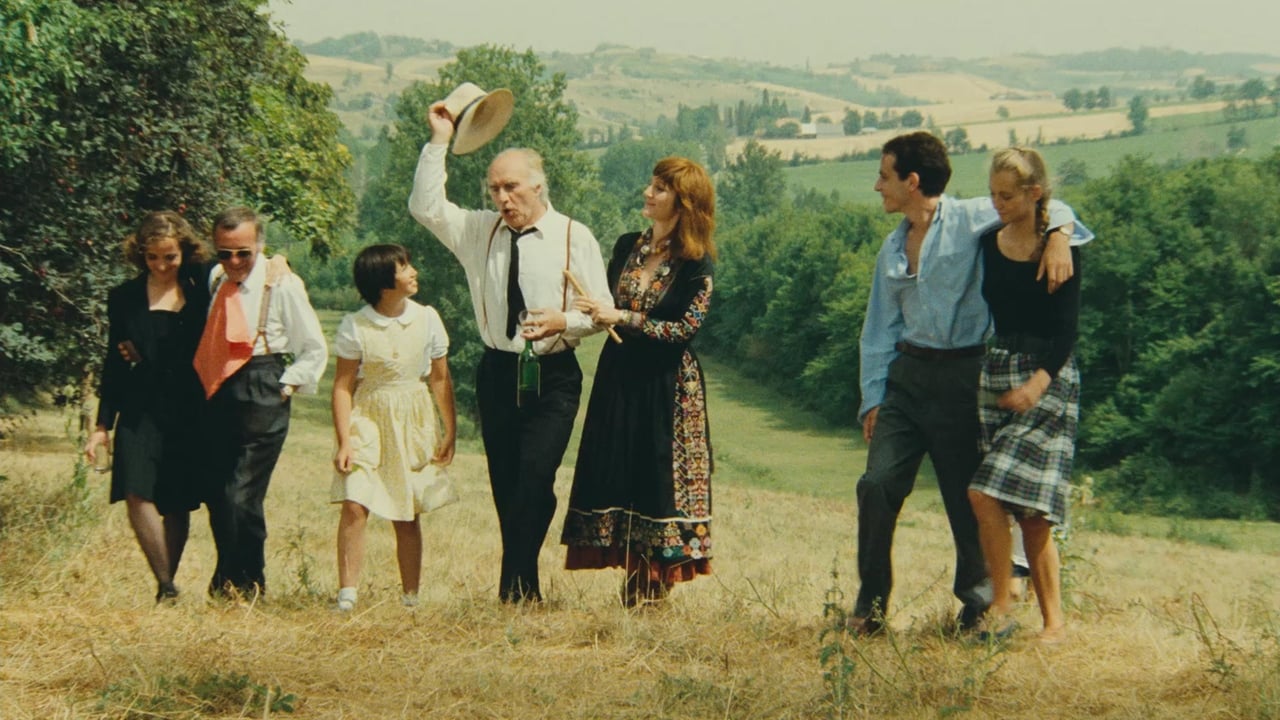
The air in Paris crackles with revolution, radio broadcasts painting frantic pictures of student protests and nationwide strikes paralyzing the capital. But miles away, nestled deep in the sun-drenched French countryside, the Vieuzac family gathers under far more intimate, though no less disruptive, circumstances. Their matriarch has suddenly passed away, and as May 1968 unfolds tumultuously beyond the confines of their sprawling, slightly decaying estate, her descendants convene for the funeral, bringing with them a lifetime’s worth of baggage – old secrets, simmering resentments, and freshly awakened desires. This is the captivating, bittersweet stage set by Louis Malle in his 1990 film May Fools (Original Title: Milou en Mai), a work that feels both deeply specific to its time and hauntingly universal in its exploration of family dynamics under pressure.
An Island in the Storm
What immediately strikes you about May Fools is its potent sense of isolation. The characters hear about the historic events engulfing France primarily through crackling radio reports or delayed news from newcomers. This physical and informational distance creates a unique crucible. While the nation grapples with potential societal collapse, the Vieuzac family is absorbed by more immediate concerns: the division of the inheritance, reignited sibling rivalries, flirtations blossoming under the May sun, and the logistical nightmare of arranging a funeral when even the gravediggers might be on strike. It’s a microcosm of bourgeois anxieties playing out against a backdrop of potential anarchy, a contrast Malle, along with his brilliant co-writer Jean-Claude Carrière (a frequent collaborator with the surrealist master Luis Buñuel), mines for both gentle comedy and poignant observation. Does national upheaval truly penetrate the bubble of personal dramas and long-held family patterns? The film seems to suggest, with a wry smile, perhaps not as much as one might think.
A Tapestry of Human Frailty
At the heart of the film is Milou, the matriarch’s son who has lived a relatively unambitious life on the estate, played with effortless charm and subtle melancholy by the legendary Michel Piccoli. Piccoli embodies Milou’s blend of dreaminess, inertia, and quiet decency perfectly. He’s a man content with the familiar rhythms of country life, suddenly thrust into a position of responsibility he seems ill-equipped – or perhaps just unwilling – to handle. Surrounding him is a pitch-perfect ensemble cast, a hallmark of Malle's directorial skill, reminiscent of the intricate character work in his earlier films like Atlantic City (1980). Miou-Miou is sharp and pragmatic as Camille, Milou’s daughter, whose modern sensibilities clash with the estate's languid pace. Michel Duchaussoy brings a world-weary cynicism as Georges, Milou's brother, arriving from the city with his own set of priorities. Each interaction, each shared meal or clandestine conversation, peels back another layer of their shared history and individual frustrations. The performances feel lived-in, authentic; you believe these people have known, loved, and irritated each other for decades. Their anxieties about property and status feel touchingly absurd given the larger context, yet utterly believable.
Pastoral Beauty, Inner Turmoil
Malle, returning to film in his native France after a period working in America, captures the sensuous beauty of the Gers region with an almost painterly eye. The lush greens, the warm sunlight filtering through trees, the unhurried pace of rural life – it all contrasts sharply with the simmering emotional chaos among the characters. The direction is unobtrusive, observational, allowing the ensemble dynamics to breathe and develop naturally. Adding immeasurably to the atmosphere is the wonderful jazz score by violinist Stéphane Grappelli. His music, sometimes buoyant and playful, sometimes deeply melancholic, perfectly underscores the film's shifting moods, mirroring the characters' own unpredictable emotional journeys. It's a score that feels intrinsically linked to the film's soul, enhancing the sense of time slowing down even as personal lives accelerate towards moments of crisis or unexpected liberation.
Retro Reflections from the Foreign Aisle
Finding May Fools tucked away in the "Foreign Films" section of the video store back in the day always felt like uncovering a hidden gem. It offered such a different flavour compared to the high-octane blockbusters dominating the shelves. This wasn’t about explosions or car chases; it was about the quiet explosions within a family, the subtle shifts in relationships, the bittersweet humour found in human imperfection. It’s interesting to note that Malle himself came from a privileged background, and one senses a degree of affectionate self-critique in the film’s gentle satire of bourgeois concerns. The film competed for the Palme d'Or at the 1990 Cannes Film Festival, a testament to its quality and resonance, even if it didn't become a mainstream hit in North America. Watching it again now, on a screen far sharper than my old CRT, the performances retain their power, and the central questions about how history shapes, or fails to shape, our intimate lives feel more relevant than ever. It’s a reminder of the sheer breadth and depth of cinema that the VHS era made accessible, pushing us beyond the obvious choices.
Final Thoughts
May Fools is a beautifully crafted film – witty, poignant, and deceptively insightful. It uses a specific historical moment not just as wallpaper, but as a catalyst, forcing its characters to confront their own lives, legacies, and desires in the sudden absence of their matriarchal anchor. The ensemble acting is superb, particularly from Piccoli, and Malle directs with a warmth and intelligence that invites empathy even as it gently skewers his characters' foibles. It’s a film that lingers, like the scent of honeysuckle on a warm evening, leaving you to ponder the intricate dance between personal dramas and the grand sweep of history.
Rating: 8.5/10
The score reflects the film's exceptional ensemble cast, nuanced script, evocative atmosphere, and Louis Malle's masterful direction. It might feel a touch slow for some contemporary viewers accustomed to faster pacing, but its rich characterizations and thoughtful exploration of themes more than justify the rating. It’s a wonderfully observed slice of life, capturing a moment where personal and political worlds threaten to collide, yet somehow remain distinctly, often comically, separate. A true standout of French cinema from the cusp of the 90s.