There's a certain kind of stillness, a quiet resistance to the world's relentless forward motion, that defines some moments in youth. It's not laziness, exactly, but a profound sense of disconnect, a feeling of observing life from behind slightly smudged glass. Watching Davide Ferrario's Tutti giù per terra (1997) again after all these years, that feeling washes right back over you, embodied perfectly by its perpetually adrift protagonist, Walter. This isn't your typical energetic coming-of-age story; it's something quieter, more introspective, and deeply rooted in the specific anxieties of mid-90s Italy.
The Weight of Aimlessness
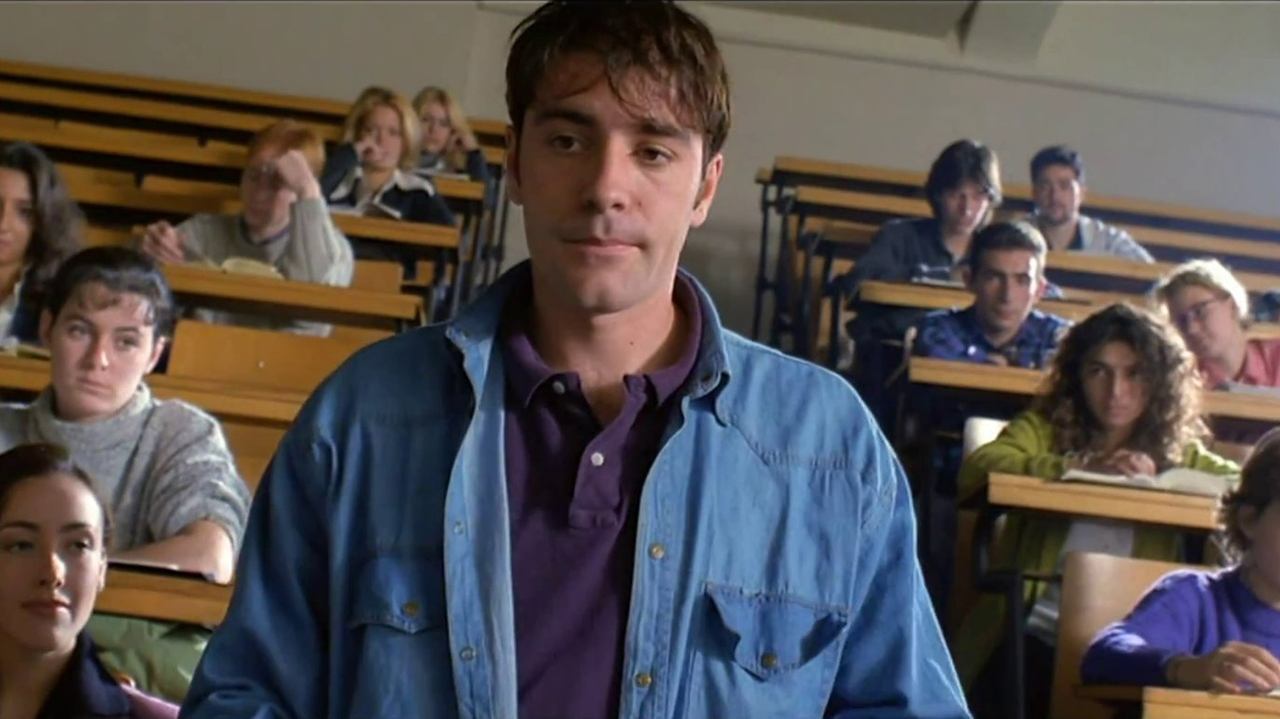
At the heart of the film is Walter, played with pitch-perfect vulnerability and deadpan irony by Valerio Mastandrea. Walter is a recent high school graduate in Turin navigating that strange limbo before mandatory military service – the dreaded "naja" that hung over young Italian men of that era. He drifts through temporary, often bizarre jobs (a human statue, a pollster asking invasive questions), half-hearted relationships, and encounters with a collection of equally lost or eccentric characters. There's no grand quest here, no singular driving ambition. Instead, Ferrario paints a portrait of inertia, of a young man passively resisting the expectations society places upon him, seemingly unsure of what he wants, or even if he wants anything specific at all.
It’s a feeling that resonated deeply in mid-90s Italy, captured first in Giuseppe Culicchia's wildly successful 1994 novel of the same name, a book that became something of a generational touchstone. Bringing that literary phenomenon to the screen, Ferrario, who also co-wrote the screenplay with Culicchia, found his ideal Walter in Mastandrea. Fresh off roles that were already defining him as the face of a certain intelligent, wryly observant, yet deeply uncertain young Italian, Mastandrea is Walter. He conveys volumes with a sideways glance, a resigned shrug, or a perfectly timed, understatedly sarcastic remark. It's a performance built on nuance, making Walter relatable even in his near-paralyzing passivity. Does his lack of direction frustrate? Sometimes. But does it feel achingly real? Absolutely.
Turin Through a Hazy Lens
Ferrario, who would later revisit Turin's unique atmosphere in films like Dopo Mezzanotte (2004), uses the city not just as a backdrop but as a character reflecting Walter's state of mind. It's not the picturesque tourist Italy, but a workaday city of arcades, slightly melancholic streets, and anonymous apartment blocks. The direction mirrors Walter’s detachment – often observational, favouring longer takes and a pace that allows moments to breathe, sometimes uncomfortably so. The film avoids easy narrative beats, opting for an episodic structure that mirrors the fragmented nature of Walter's experiences.
This patient approach allows the film's dry, situational humor to land effectively. Walter's experiences, particularly during his brief, Kafkaesque stint in the military, are often absurd, highlighting the often-illogical structures one bumps up against in life. There’s also a memorable turn by the late, great Tuscan actor Carlo Monni as Walter's anarchist uncle, offering a different flavour of societal detachment.
Retro Fun Facts: Echoes of Culture
Beyond Mastandrea's defining performance, Tutti giù per terra carries some fascinating cultural footnotes. Adding layers of almost meta-commentary are appearances by figures like Caterina Caselli. A massive pop star in the 60s with hits like "Nessuno mi può giudicare," Caselli transitioned into becoming one of Italy's most powerful record producers, discovering major talents. Seeing her here, in a small but significant role, feels like a wink to the very cultural establishment Walter seems adrift from. Similarly, Benedetta Mazzini, who plays one of Walter's fleeting love interests, is the daughter of the legendary Italian singer Mina, adding another subtle layer of pop culture resonance for Italian audiences of the time. It's these kinds of connections, woven into the fabric of the film, that make revisiting it feel like unearthing a time capsule. The source novel's success was substantial, tapping into a widespread feeling; the film, while perhaps less of a phenomenon, captured that same spirit on screen with remarkable fidelity.
A Quietly Resonant Portrait
Tutti giù per terra isn't a film that shouts its themes from the rooftops. It’s a subtle critique of societal expectations, the often-alienating transition to adulthood, and the search for identity in a world that doesn't always offer clear paths. It doesn’t offer easy answers or neat resolutions, mirroring the uncertainty it portrays. Walter's journey, or lack thereof, might not be for everyone. If you walked into the video store back then looking for explosive action or broad comedy, you might have felt baffled, maybe even returned the tape early.
But if you connect with character studies, with films that capture a specific mood and moment in time, there's a quiet power here. It’s a film that understands the feeling of being young and unsure, not with romanticism, but with clear-eyed empathy and a touch of wry humor. It asks, perhaps, what happens when the prescribed paths – job, family, conformity – feel utterly alien? What does resistance look like when it’s passive rather than active?
Rating: 7/10
This score reflects the film's undeniable strengths – Mastandrea's definitive performance, the authentic capture of a specific generational mood and cultural context, and Ferrario's assured, atmospheric direction. It successfully translates the spirit of a significant novel to the screen. However, its deliberately slow pace and episodic nature might test the patience of some viewers, and its deep roots in 90s Italian specifics might make some nuances less immediate to an international audience unfamiliar with that context (like the cultural weight of "naja" or the significance of the cameos). It's a film that rewards patience and resonates most strongly if you appreciate mood pieces over plot-driven narratives.
What lingers most after the credits roll isn't a dramatic climax, but the persistent image of Walter, observing the world with those intelligent, slightly weary eyes. It's a snapshot of a feeling, a time, and a place, preserved on flickering magnetic tape, waiting to be rediscovered.