It starts with a glimpse. A flash of familiarity where it shouldn't be, seen through a rain-streaked window. For Grace King Bichon, played with simmering vulnerability by Julia Roberts, that glimpse shatters the comfortable facade of her picture-perfect Southern life. And just like that, Something to Talk About (1995) pulls us into the messy, uncomfortable, and often surprisingly funny fallout when the unspoken truths of a marriage and a family are dragged kicking and screaming into the light. This wasn't just another rom-com cluttering the New Releases shelf at Blockbuster; there was a sharper edge here, a current of genuine hurt beneath the glossy surface, thanks largely to the pen of Callie Khouri, fresh off her Oscar win for Thelma & Louise (1991).

Southern Discomfort
Director Lasse Hallström, already known for finding the heart in quirky character studies like What's Eating Gilbert Grape (1993), leans into the specific atmosphere of the affluent, horse-centric South. The sprawling farms, the ingrained traditions, the suffocating politeness – it all creates a potent backdrop for Grace's very public humiliation when she discovers her husband Eddie's (Dennis Quaid) infidelity. There’s a sense that appearances are everything in this world, which makes Grace’s eventual refusal to play along all the more explosive. The film captures that feeling of being trapped not just by a bad marriage, but by the expectations of an entire community, beautifully filmed in locations like Beaufort, South Carolina, adding layers of authentic Southern charm that ironically heighten the central conflict.
A Woman Finding Her Voice

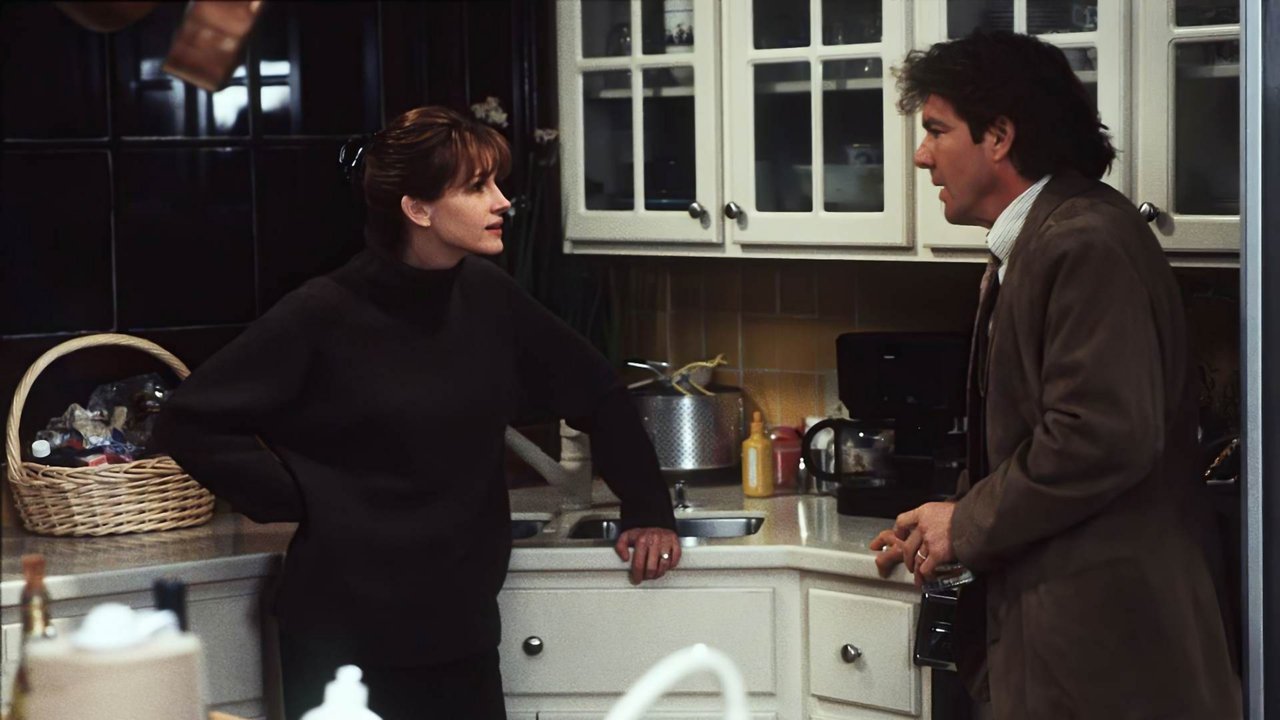
This film lives and breathes with Julia Roberts' portrayal of Grace. It’s a performance that moves beyond her typical "America's Sweetheart" persona of the era. We see her initial shock, the quiet devastation, morph into righteous anger, and finally, into a bewildered sort of strength. Who can forget the scene where she confronts Eddie and his mistress mid-rendezvous? Or, even more pointedly, the legendary sequence at the charity league meeting? Standing before the town's matriarchs, simmering with fury and a touch of desperate clarity, Grace asks point-blank, "Adultery. Has your husband ever been unfaithful?" The stunned silence, the nervous shifting – it’s a masterclass in tension and dark humor, a moment where the carefully constructed social order cracks wide open. It’s the kind of scene that cemented this movie in memory, a raw nerve touched with uncomfortable truth. It feels entirely like something Callie Khouri, who reportedly drew inspiration for the script after witnessing a public argument, would fight to keep unflinchingly honest.
Family Ties and Scene Stealers
While Roberts is the anchor, the supporting cast is exceptional. Robert Duvall as Grace's father, Wyly King, is pitch-perfect – the stern patriarch who loves his daughter but is deeply entrenched in the old ways, initially more concerned with propriety than her pain. His scenes with Grace, particularly as he grapples with his own past, add unexpected depth. Gena Rowlands brings her signature gravitas to Georgia King, Grace’s mother, torn between supporting her daughter and maintaining the family’s equilibrium. But let's be honest, who walked away from this movie not talking about Kyra Sedgwick? As Grace's fiercely loyal, sharp-tongued sister Emma Rae, Sedgwick delivers an absolute firecracker of a performance. Her drawl, her take-no-prisoners attitude, her unwavering defense of Grace – she practically vibrates with energy in every scene, stealing moments with perfectly timed lines and expressive reactions. She provides not just comic relief, but a vital source of strength and perspective for Grace. Dennis Quaid, meanwhile, has the challenging task of portraying Eddie, the charming rogue who causes all the trouble. He leans into the character's charisma, making it believable why Grace fell for him, but perhaps the script doesn't quite give him the space to fully explore the complexities of his betrayal and potential redemption, which can feel a little abrupt.

Beyond the Gloss (Retro Fun Facts)
It's interesting to remember this film landed in a period absolutely dominated by Roberts' star power. While Something to Talk About wasn't the colossal box office smash of Pretty Woman (1990), it performed respectably (around $50 million domestic on a reported $30 million budget), finding its audience likely through strong word-of-mouth and its resonant themes. The original title, Grace Under Pressure, was apparently changed to avoid confusion with the popular sitcom Grace Under Fire, a sensible move in hindsight. What resonates now, watching it on a perhaps slightly fuzzy transfer that mimics that old VHS feel, is how Hallström balances the comedic elements with the genuine pain of the situation. It never tips fully into farce, nor does it wallow solely in melodrama. He allows the awkwardness and the anger to coexist, much like real family conflicts do.
Lasting Impressions
Does Something to Talk About feel distinctly '90s? Absolutely. The fashion, the specific brand of marital strife, even the slightly neater-than-life resolution might feel characteristic of its time. Yet, the core questions it raises – about fidelity, about finding your voice within restrictive family or societal structures, about whether forgiveness is possible or even desirable – remain surprisingly relevant. It explores the uncomfortable truth that sometimes, the people closest to you are the ones most invested in your silence. The film doesn't offer easy answers, but it validates the messy, complicated process of demanding to be heard.

Rating: 7/10
This score reflects the film's undeniable strengths: Khouri's sharp, insightful script, powerhouse performances (especially from Roberts and the unforgettable Sedgwick), and Hallström's sensitive direction that finds nuance in the Southern setting. It avoids a higher score mainly because Quaid's character arc feels slightly underdeveloped, and the ending, while satisfying on one level, perhaps ties things up a bit too conventionally given the raw honesty of Grace's journey.
Ultimately, Something to Talk About remains a compelling watch, a 90s relationship drama that offered more bite than typical fare. It’s a film that reminds us that sometimes, disrupting the peace is the only way to find any. What truly lingers is the satisfying spark of Grace finally refusing to just smooth things over – a spark that still feels warmly familiar, like catching sight of a well-loved tape on the shelf.