Okay, pull up a comfy chair, maybe grab a slightly worn cushion that remembers the shape of your head from countless movie nights. Let's talk about a film that arrived on video store shelves in 1992 like, well, a stranger among the usual action blockbusters and slasher flicks: Sidney Lumet's A Stranger Among Us. It’s one of those films that perhaps flickered across your CRT screen once or twice, leaving a faint, intriguing impression rather than a seismic jolt. What lingers, I find, isn't necessarily the central mystery, but the quiet collision of worlds it depicts.

Where Worlds Brush Against Each Other
The premise itself feels ripped from a different kind of procedural: Detective Emily Eden (Melanie Griffith), a tough, seen-it-all New York cop, goes undercover within the deeply insular Hasidic Jewish community in Brooklyn to investigate the murder of a diamond cutter. It's a classic fish-out-of-water setup, but under the veteran hand of Lumet – the director who gave us searing urban portraits like Serpico (1973) and Dog Day Afternoon (1975) – it aims for something more than cheap culture-clash gags. Lumet, ever the chronicler of New York's intricate social fabrics, seems genuinely fascinated by the textures and rhythms of this particular closed society.
He, along with writer Robert J. Avrech (who brought his own Orthodox Jewish background to the script, lending crucial authenticity), works hard to paint the Hasidic world not as exotic or alien, but as a place of deep faith, tradition, and specific, lived-in rules. There’s a tangible atmosphere captured in the scenes within the community – the quiet intensity of prayer, the warmth of family gatherings, the meticulous adherence to ancient customs. It’s filmed with respect, avoiding easy caricature. This careful depiction, reportedly aided by consultants from the community and filming partially on location in Borough Park, Brooklyn, is arguably the film's strongest asset.
Eden in the Garden of Faith
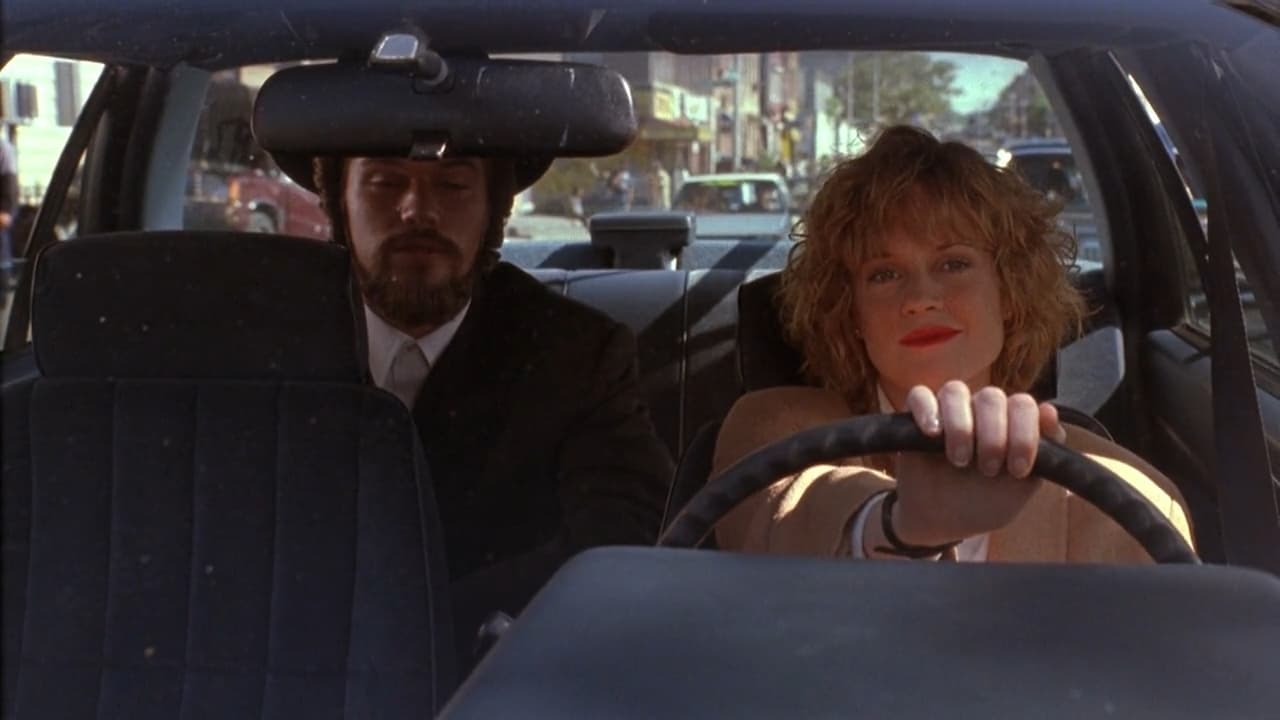
At the heart of this exploration is Melanie Griffith. Riding high on her late 80s/early 90s stardom following Working Girl (1988), Griffith certainly looks the part of the street-smart cop, perhaps a bit too glamorous, maybe a touch too reliant on that trademark breathy voice. Does she fully disappear into the role of Emily Eden? That’s debatable, and indeed, her casting was a point of discussion even back then. Some critics found her portrayal somewhat jarring against the meticulous backdrop Lumet created. Yet, there's a vulnerability she brings that works, particularly as Eden finds herself increasingly drawn to the community's spiritual depth and, more specifically, to Ariel (Eric Thal), the gentle, scholarly young man poised to become the next Rebbe.
Griffith reportedly spent time with female NYPD officers and within the Hasidic community to prepare, and you can see the effort in her portrayal of Eden’s gradual softening, her questioning of her own hardened, secular life. The script gives her moments of genuine reflection, forcing her (and us) to consider what constitutes a meaningful existence. Thal, as Ariel, provides a quiet counterpoint – his performance is imbued with a gentle sincerity that makes the burgeoning, forbidden connection between him and Eden feel surprisingly tender, if perhaps underdeveloped. Supporting players like John Pankow, as Eden's cynical partner, effectively represent the gritty outside world she temporarily leaves behind.
When Plot Meets Piety
Here’s where things get a bit… uneven. While the cultural immersion is fascinating, the actual crime thriller plot feels somewhat secondary, almost perfunctory. The identity of the killer isn't particularly shocking, and the procedural elements lack the usual Lumet tension. It feels like the director was far more invested in exploring the spiritual and cultural landscape than in crafting a truly gripping whodunit. This led to mixed reviews upon release – praise for the respectful portrayal of the Hasidic community often came alongside criticism of the conventional, predictable thriller framework. The film even competed at the 1992 Cannes Film Festival, a testament perhaps more to Lumet's pedigree than the film's overall knockout power. Financially, it didn't quite connect either, struggling to recoup its estimated $18 million budget at the box office.
It’s tempting, perhaps unavoidable, to compare it to Witness (1985), another film about a cop hiding out in a closed religious community (the Amish). While Witness arguably achieved a more potent blend of suspense, romance, and cultural observation, A Stranger Among Us carves its own, quieter niche. It feels less about immediate danger and more about a slow, internal transformation.
Retro Fun Facts
Digging into the VHS vault often unearths little nuggets. For instance, the film's commitment to authenticity extended to details many viewers might miss, reflecting Avrech's insider perspective. Lumet, known for his intense rehearsal periods with actors, likely focused heavily on capturing the nuances of interaction between Griffith's outsider character and the community members. The tagline, "To solve a murder, she had to enter a world where she didn't belong. To find the killer, she had to break the rules," really played up the culture-clash thriller angle, perhaps slightly overselling the suspense element compared to the film's more contemplative reality.
The Echo in the Quiet Streets
So, popping this tape into the VCR today... what resonates? It’s the quiet moments. The shared meal. The hesitant questions about faith. The way Lumet frames the contrast between the noisy chaos of Eden's usual beat and the structured serenity she finds herself immersed in. It’s a film less about solving a crime and more about finding – or perhaps questioning – one's place in the world. Is the structure holding the community together stifling, or is it liberating in its clarity? Does Eden's tough exterior truly protect her, or has it merely isolated her? These are the questions that linger longer than the mystery plot.
A Stranger Among Us isn't a forgotten masterpiece, nor is it peak Lumet or Griffith. It’s a fascinating, slightly flawed artifact of its time – a mainstream studio picture attempting a sensitive portrayal of a rarely seen community, wrapped in the familiar guise of a cop thriller. It doesn't quite nail the blend, but its sincerity and the thoughtful glimpse into another world make it a worthwhile curiosity from the shelves of VHS Heaven.
Rating: 6/10
Justification: The score reflects the film's admirable and sensitive portrayal of the Hasidic community and Lumet's typically solid craftsmanship, weighed against a predictable, underdeveloped thriller plot and a central performance from Griffith that, while earnest, doesn't always feel entirely grounded in the film's world. It succeeds more as a cultural study than a crime story.
Final Thought: It leaves you pondering less about who pulled the trigger, and more about the invisible walls we build around ourselves, and what happens when someone unexpectedly finds a way inside.