It’s a premise that likely stopped you in your tracks while browsing the ‘New Releases’ wall at Blockbuster back in 1997: a wealthy, eccentric 1930s socialite raises an infant gorilla as her own child amidst a household already teeming with chimpanzees, dogs, horses, and exotic birds. Based on a true story, Caroline Thompson’s Buddy isn't quite the straightforward heartwarming animal tale the poster might suggest. Instead, it offers a more complex, sometimes unsettling, and ultimately poignant look at the blurred lines between affection and obsession, nature and nurture. Does the memory of this unusual film still echo faintly, like a strange dream half-recalled?
An Eccentric Ark
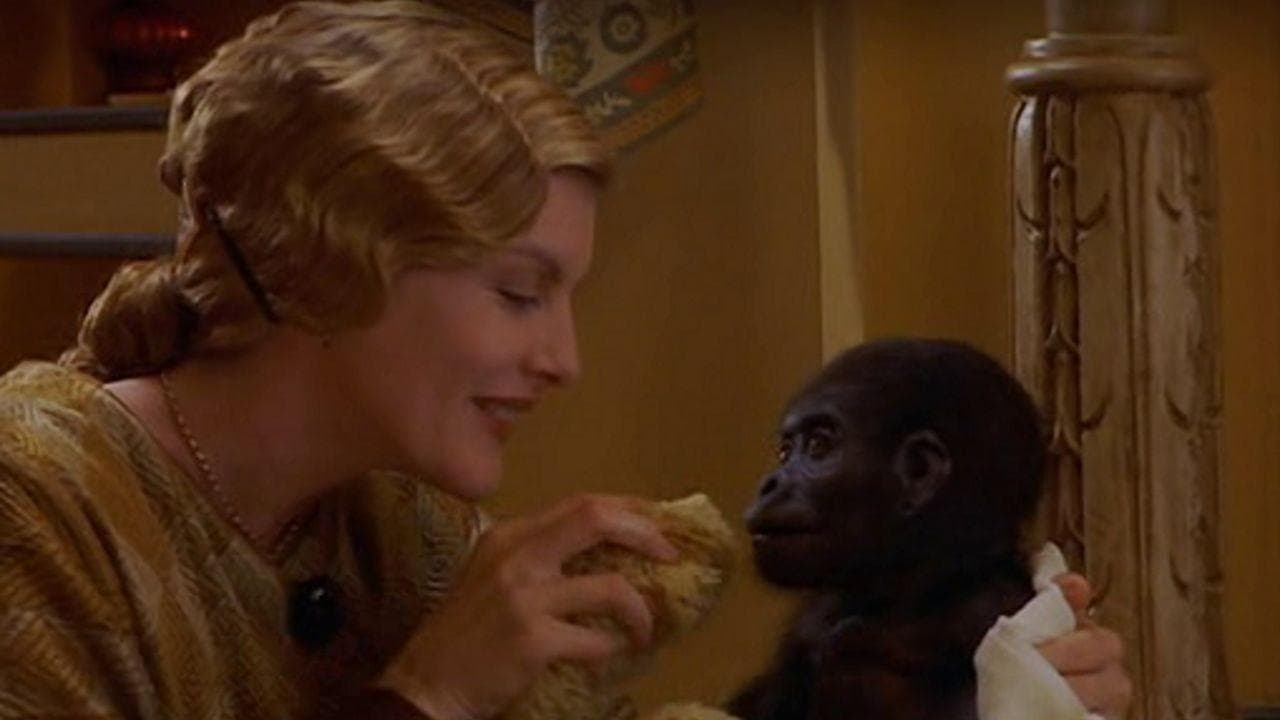
We are invited into the opulent, chaotic world of Gertrude "Trudy" Lintz (Rene Russo), a woman whose passion for animals borders on the visionary, or perhaps the dangerously naive. Her sprawling New York estate is less a home and more a personal, unconventional zoo, managed with the bemused tolerance of her kindly physician husband, Dr. Bill Lintz (Robbie Coltrane), and the help of devoted assistant Dick (Alan Cumming). When Trudy rescues a gravely ill baby gorilla, christening him Buddy, her maternal instincts surge, treating him not merely as a pet, but as a human infant – dressed in clothes, seated at the dinner table, taught manners. It's a spectacle both charming and deeply concerning, immediately posing questions about the ethics of such an endeavor.
The Heart and the Hurt
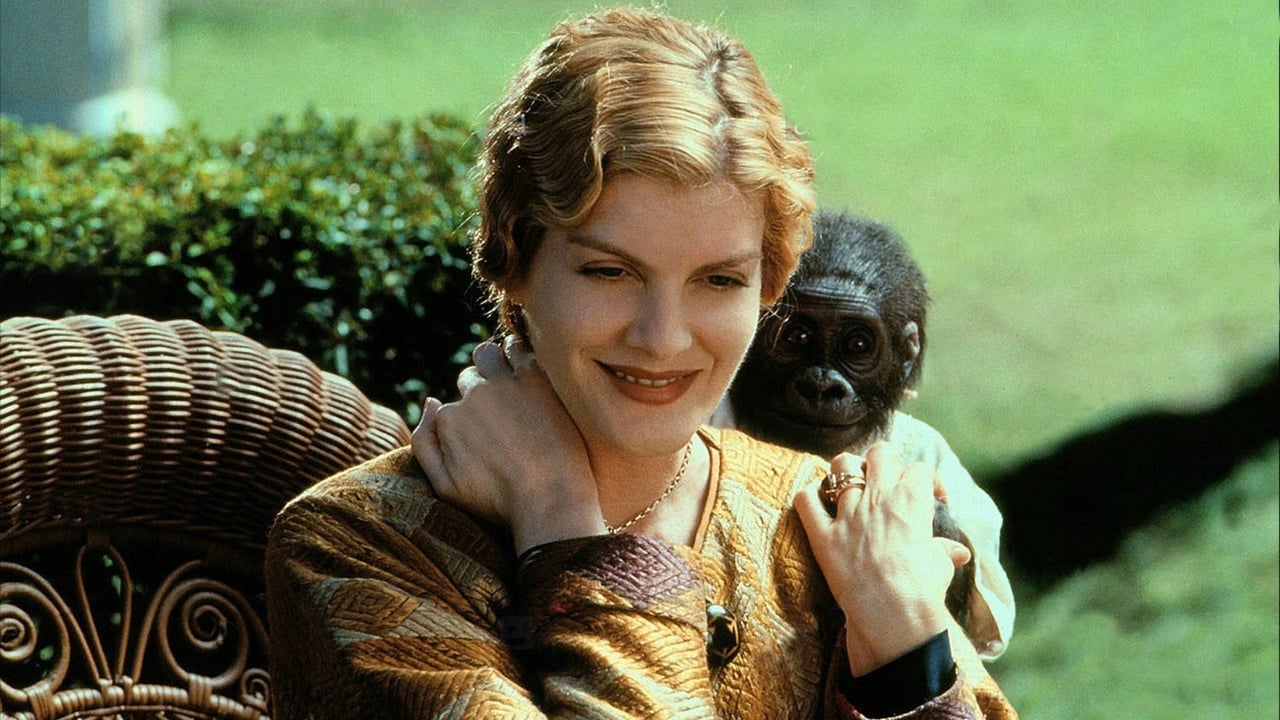
Rene Russo delivers a fascinating performance as Trudy. She embodies the character's boundless enthusiasm and genuine love for her animals, making her affection palpable. Yet, Russo skillfully avoids simple caricature, allowing glimpses of the underlying fragility and perhaps the profound loneliness driving Trudy's need to mother these creatures. There's a fierce determination in her eyes, but also a refusal to acknowledge the inherent wildness that cannot be entirely domesticated. It's a performance that feels truthful in its complexity; we understand her motivations even as we question her judgment. How much of her care is for the animals, and how much is fulfilling a need within herself?
Opposite Russo, Robbie Coltrane (known to many through the Harry Potter series, but a UK screen veteran long before) provides the film's gentle anchor as Bill. He’s supportive but increasingly worried, his quiet pragmatism a necessary counterpoint to Trudy's extravagant eccentricities. Alan Cumming, bringing his signature quirky energy, offers moments of levity but also serves as another voice of subtle caution. Their performances ground the film, preventing Trudy's world from spiraling entirely into unbelievable fantasy.
Bringing Buddy to Life: A Creature Shop Marvel
A crucial element, of course, is Buddy himself. Brought to life by the legendary Jim Henson's Creature Shop, the animatronics and suit performance (primarily by Peter Elliott, among others) are remarkable for the era. This wasn't CGI; this was intricate puppetry and physical performance requiring immense skill. There's a tangible weight and presence to Buddy, allowing for moments of genuine emotional connection, particularly in his younger years. The Creature Shop reportedly faced significant challenges ensuring Buddy could convey a range of emotions convincingly while also performing complex physical actions. While the effect might seem dated compared to modern digital creations, there’s an undeniable artistry and soulfulness in this practical approach that resonates with the film's tangible, historical setting. Wasn't there something genuinely captivating about the sheer craft of such practical effects back then?
Retro Fun Facts:
- Director/writer Caroline Thompson has a clear affinity for outsiders and darkly whimsical tales, having penned Tim Burton's Edward Scissorhands (1990) and The Nightmare Before Christmas (1993), as well as The Addams Family (1991). This sensibility permeates Buddy, giving it an undertone that’s more complex than many family films of the period.
- The film is based on the real Gertrude Lintz, who documented her experiences in books like "Animals Are My Hobby." The real Buddy, later known as Gargantua the Great, had a far more tragic life after leaving Trudy's care, eventually becoming a notoriously aggressive circus attraction – a stark contrast to the film's more bittersweet conclusion. Thompson chose to focus on the earlier, more idyllic (if flawed) period.
- Creating Buddy was a feat. The main suit reportedly weighed over 70 pounds, and complex scenes often required multiple operators working in concert – some controlling facial expressions via remote, others handling body movements from inside or externally.
- Despite the pedigree of its creators and stars, and the unique true story, Buddy was a notable box office disappointment, struggling to find its audience. Perhaps its blend of family-friendly visuals with more troubling thematic undercurrents proved difficult to market effectively in 1997.
Beneath the Whimsy: Uncomfortable Questions
As Buddy grows from an adorable infant into a powerful, unpredictable adolescent gorilla, the film confronts the inevitable consequences of Trudy's experiment. The carefully constructed domesticity shatters against the reality of Buddy's immense strength and burgeoning wild instincts. Thompson doesn't shy away from the danger and the heartbreak inherent in the situation. The film leaves viewers pondering difficult questions: Can wildness truly be tamed? Is it ethical to impose human standards and environments on animals incapable of consenting? What responsibility do we bear for the lives we choose to interfere with? The score, by Elmer Bernstein, subtly underscores this shifting tone, moving from lighthearted melodies to more somber, reflective pieces as the narrative progresses.
The film's atmosphere is unique – a blend of 1930s period detail, almost fairytale-like eccentricity, and a growing sense of unease. It captures a specific kind of gilded cage, beautiful on the surface but ultimately confining for its magnificent central inhabitant.
Legacy of an Oddity
Rewatching Buddy today, it feels like a curious artifact from a time when studios occasionally took chances on stranger, harder-to-categorize stories, even within a family film framework. It lacks the easy reassurances of many animal movies, opting instead for a more melancholy and ambiguous reflection on love, loss, and the complicated, often fraught, relationship between humans and the animal kingdom. Its themes feel perhaps even more relevant now, in an age grappling with conservation, animal rights, and the ethics of captivity. What specific feeling or question lingers most powerfully after the film concludes? For many, it might be a profound sense of sympathy for Buddy, caught between two worlds, belonging fully to neither.
Rating: 6/10
Buddy earns a 6 for its ambition, Rene Russo's committed performance, and the impressive practical effects work from Jim Henson's Creature Shop. It successfully evokes a unique atmosphere and raises thought-provoking questions. However, the film occasionally struggles with tonal consistency, sometimes unsure whether to lean into whimsical family fare or the darker implications of its true story. The pacing can feel uneven, and the resolution, while poignant, might leave some viewers feeling unresolved. It’s a film whose reach perhaps exceeds its grasp, but its willingness to explore complex emotional territory within its peculiar premise makes it a memorable, if imperfect, piece of 90s cinema.
Final Thought: Buddy remains a fascinating, flawed gem—a testament to a time when even family-oriented films dared to be a little strange, leaving us with lingering questions about the nature of love and the wild heart that cannot, and perhaps should not, be entirely tamed.