What happens when a notorious charlatan, a self-proclaimed master of occult sciences, finds himself tangled in the very human complexities of love he claims to manipulate? That’s the delightful, surprisingly thoughtful territory explored in Mark Zakharov’s 1984 Soviet television gem, Formula of Love (Формула любви). Forget the typical 80s blockbuster fare for a moment; this is a different kind of magic, the kind found not on dusty American video store shelves, but perhaps discovered through a grainy nth-generation dub, a whisper among film enthusiasts seeking something unique from behind the Iron Curtain. It’s a film that charms not with explosions, but with wit, warmth, and a gentle questioning of the heart's enigmatic alchemy.
The Count Comes Calling
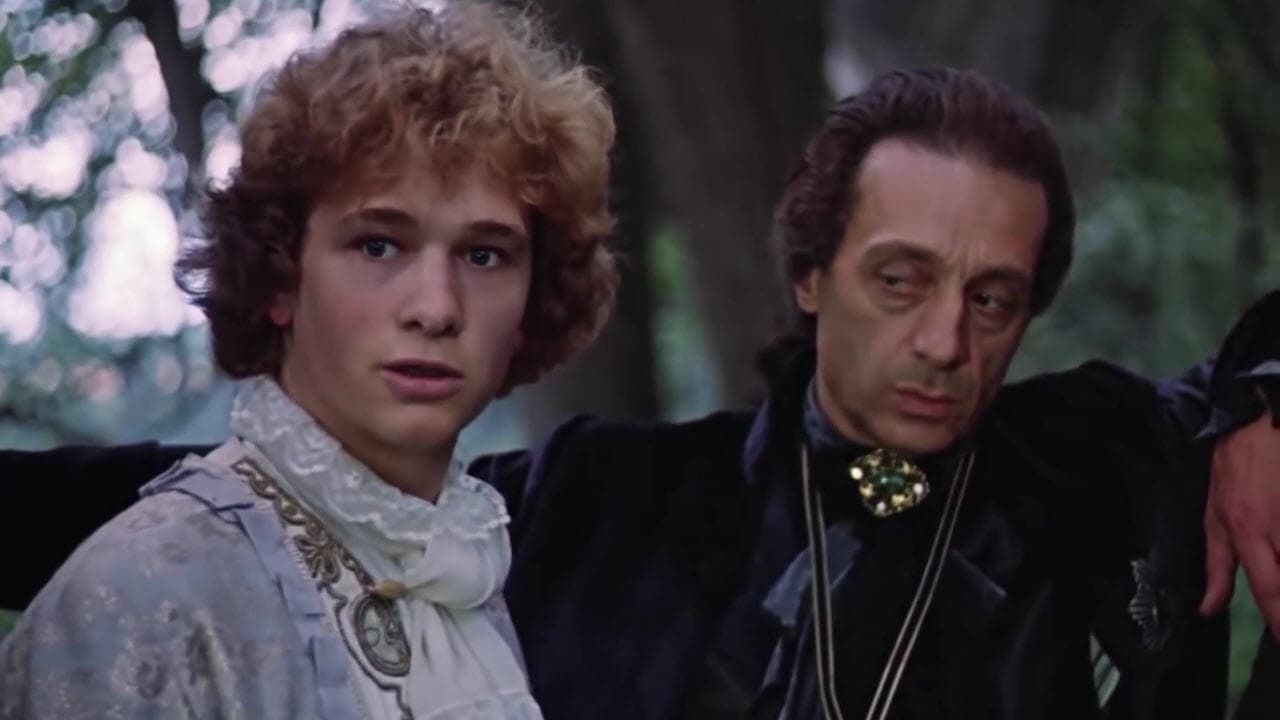
The premise itself sparkles with potential: the infamous Count Cagliostro (Nodar Mgaloblishvili), fleeing St. Petersburg authorities with his small, eccentric entourage, finds himself stranded in the Russian countryside. Nearby lives a young, lovelorn nobleman, Alexei Fedyashev (Aleksandr Mikhaylov), who is desperately pining for a statue he glimpsed in the city. Hearing of the Count's supposed powers, Alexei implores him to "materialize" his idealized love. Cagliostro, ever the opportunist but also deeply weary of his own deceptions, agrees, setting the stage for a collision between calculated illusion and unexpected reality. What unfolds is less a straightforward fantasy and more a whimsical meditation on desire, belief, and the absurdity of trying to rationalize romance.
Beyond the Illusion

What elevates Formula of Love beyond mere romantic comedy is its gentle philosophical underpinning, courtesy of screenwriter Grigori Gorin (a frequent collaborator with Zakharov, known for works like The Very Same Munchhausen). Cagliostro, portrayed with a magnificent blend of cynicism, charisma, and subtle melancholy by Nodar Mgaloblishvili, isn't just a trickster; he's a man burdened by the emptiness of his own creations. It's fascinating trivia that Mgaloblishvili, a Georgian actor, was actually dubbed by the legendary Armenian actor Armen Dzhigarkhanyan, whose resonant voice became inseparable from the character for millions of viewers. This Cagliostro seems almost desperate to believe in something real, even as he cynically manipulates the naive Alexei.
Opposite him, Aleksandr Mikhaylov perfectly captures Alexei's earnest, almost foolish romanticism. He’s not just lovesick; he represents a pure, unadulterated belief in ideals, a stark contrast to the Count's jaded worldview. And then there's Masha (Elena Valyushkina), the landowner's daughter who becomes entangled in Cagliostro's scheme. Valyushkina imbues Masha with a quiet intelligence and blossoming self-awareness. She sees through the pretense, yet finds herself drawn not to the illusion, but to the flawed humanity struggling beneath it. Her journey, alongside Alexei's, forms the film's tender heart. Does the formula for love lie in grand mystical gestures, or in the simple, messy business of human connection? The film playfully, wisely, suggests the latter.
Airing Out the 18th Century
Mark Zakharov's direction, honed through acclaimed stage and television work, brings a distinct theatrical flair without feeling stage-bound. Shot mainly on location at picturesque Russian estates near Moscow, the film possesses an authentic sense of place, grounding its fantastical elements. The supporting characters, like the pragmatic Margadon and the perpetually anxious Jacob, add layers of humor and relatable human foible.
And one simply cannot discuss Formula of Love without mentioning the music. Gennady Gladkov's score and Yuli Kim's lyrics resulted in songs that became instantly iconic and remain beloved cultural touchstones. Tracks like "Uno Uno Uno Un Momento" are more than just catchy tunes; they're woven into the film's fabric, commenting on the action, revealing character, and encapsulating the movie's blend of irony and sentimentality. For anyone who grew up with Soviet cinema, these melodies evoke instant recognition, much like a beloved pop hit might for Western audiences of the era.
A Different Kind of Retro Discovery
While perhaps not a staple of the average Blockbuster Video night in the West, Formula of Love represents the kind of treasure VHS hunting could unearth – a film operating on a different wavelength, offering humor derived from character and situation rather than slapstick, and romance built on subtle glances and philosophical sparring. It’s a reminder that the 80s produced gems far beyond the Hollywood mainstream. Its production, typical for Soviet TV films of the time, likely operated on constraints that forced creative solutions, resulting in a focus on strong writing and performance over elaborate effects – a quality many of us cherish in retrospect. The film gently satirizes superstition and pomposity, but its core message about the authenticity of feeling remains touchingly sincere.
Rating: 8/10
Formula of Love earns this rating for its enduring charm, intelligent script, wonderful performances, and iconic music. It's a witty, warm, and surprisingly resonant film that uses its historical fantasy setting to ask timeless questions about love, belief, and the masks we wear. It might lack the visual bombast of its Western contemporaries, but its heart and humor offer a different, deeply satisfying kind of cinematic magic.
It leaves you pondering not the secrets of the occult, but the far more mysterious territory of the human heart – a place where no formula truly applies, and perhaps that’s the most wonderful discovery of all.