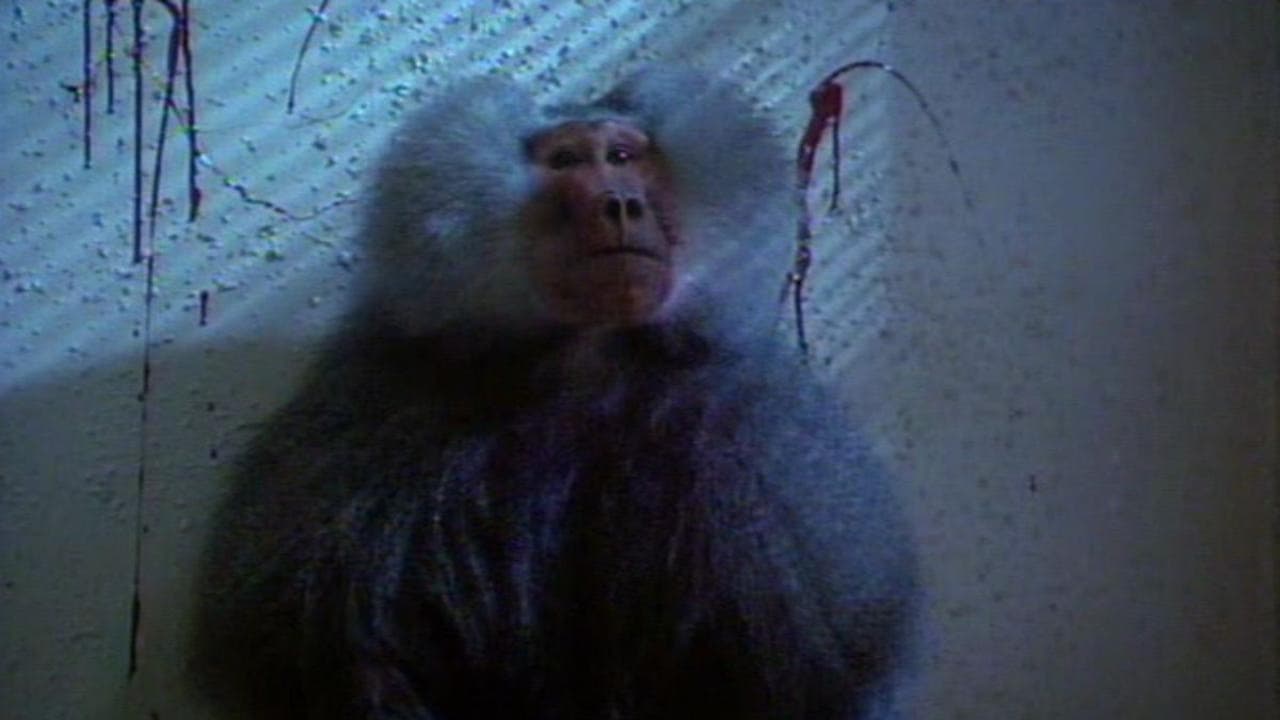
The glint of intelligence – no, something sharper, more primal – in those simian eyes. That’s the image that often sticks from Shakma. Long after the slightly dodgy LARPing costumes and the earnest-but-stilted dialogue fade, the sheer unnerving presence of the titular baboon lingers. It’s a film that operates on a frequency somewhere between high-concept absurdity and genuine, claustrophobic terror, a frequency perfectly tuned to late-night VHS viewing where reality feels thin and anything seems possible within the flickering cathode ray glow.

The Game Turns Deadly
The setup for Shakma (1990) is pure B-movie gold, feeling like something cooked up after one too many slices of cold pizza during an all-night gaming session. A group of medical students, led by Professor Sorenson (Roddy McDowall in a brief, paycheck-cashing appearance), engage in a live-action role-playing game sprawling across multiple floors of their university's medical research building after hours. Simultaneously, one of their subjects, the baboon Shakma, has been subjected to experiments designed to inhibit aggression. Naturally, the procedure backfires spectacularly, cranking the primate’s rage to lethal levels. When Sorenson leaves for the night, locking the building down via a new electronic system (because of course), the students find their fantasy game violently interrupted by a very real, very hairy, and very, very angry monster.
Primate Panic on a Budget

Let’s be honest, the human element here isn't exactly Shakespeare. Christopher Atkins (The Blue Lagoon (1980)), shedding his teen idol image, plays Sam, the sensitive student who designed the game and feels responsible. Amanda Wyss, forever etched in horror memory from A Nightmare on Elm Street (1984), is Tracy, the capable female lead trying to survive alongside him. Ari Meyers (Kate & Allie) plays the younger, more vulnerable Kim. The performances are… serviceable, hampered by a script from Roger Engle that prioritizes frantic running and occasional exposition over deep character work. But you didn't rent Shakma for nuanced human drama, did you?
No, the undisputed star is the baboon, Typhoon (credited as "Shakma"). And this is where the film finds its unsettling power, even amidst the undeniable cheese. Directors Tom Logan and Hugh Parks wisely let the animal do the heavy lifting. There's a disturbing reality to the attacks precisely because it's a real animal, not a man in a suit or dodgy CGI. The way Shakma moves, screeches, and bursts through doors feels genuinely threatening. Stories from the set often mention the inherent danger and precautions needed when filming with Typhoon; apparently, the animal bit one of the trainers during production, a grim reminder that the menace wasn't entirely manufactured. This behind-the-scenes frisson bleeds onto the screen, adding an uncomfortable edge to the chaos. You can almost feel the actors' genuine apprehension in certain scenes.
Corridors of Dread
The film makes effective, if repetitive, use of its single primary location – reportedly the defunct Pan American Hospital in Miami, Florida. The endless, sterile corridors, labs filled with ominous equipment, and echoing stairwells become a character in themselves. It amplifies the feeling of being trapped, hunted, with nowhere truly safe to hide. The score tries its best to ratchet up the tension, leaning heavily on sharp strings and percussive hits whenever Shakma appears. While the direction isn't revolutionary, it understands the core appeal: putting relatable (if thinly sketched) characters in an enclosed space with an unpredictable force of nature. The low budget (rumored to be around $2 million, a modest sum even then) is palpable, but the filmmakers leverage the constraints into a lean, mean chase structure. There's little fat here; once Shakma escapes, it's a relentless series of desperate scrambles for survival.
Retro Fun Facts: The Shakma Files
- Marketing Mayhem: The iconic poster art, often featuring the baboon menacingly looming over terrified victims, and taglines like "Man Is The Endangered Species" perfectly sold the film's exploitative premise on video store shelves.
- Direct-to-Video Destiny: Shakma largely bypassed theaters, finding its audience directly on VHS, cementing its status as a cult discovery for ravenous horror fans browsing the aisles.
- Baboon Blues: Besides the reported bite incident, working with Typhoon presented constant challenges, requiring careful coordination between trainers, actors, and crew to capture the necessary moments of primate fury safely. It's a testament to practical effects filmmaking, even if the "star" was occasionally uncooperative.
- Genre Trappings: It sits squarely in the "killer animal" subgenre popularised by Jaws (1975), but with a distinctly weird 90s twist thanks to the LARPing element – a cultural artifact in itself.
A Cult Oddity Worth Unearthing?
Shakma is undeniably goofy. The premise is bonkers, the acting is often stiff, and the dialogue occasionally induces winces. Yet… it works, on its own strange terms. The practical "effect" of the real baboon is genuinely effective, creating moments of startling violence and primal fear. The claustrophobic setting enhances the tension, and the sheer relentless pace keeps you hooked, even as you chuckle at the absurdity. It’s the kind of film perfectly suited for rediscovery, a relic from an era where high-concept B-movies could still deliver a peculiar, unforgettable thrill. Does that central baboon performance still feel unnerving? Absolutely.
Rating: 6.5 / 10
Justification: The score reflects Shakma's status as a highly entertaining B-movie cult classic rather than a conventionally "good" film. It earns points for its genuinely effective use of a real animal antagonist, the resulting moments of palpable tension, its claustrophobic atmosphere, and its sheer memorable oddity. It loses points for weak characterization, often stilted dialogue, and repetitive plotting. It's flawed but fun, a perfect slice of late-night VHS weirdness.
Final Thought: Shakma remains a fascinatingly bizarre footnote in 90s horror – proof that sometimes, all you need is a locked building, some questionable fashion choices, and one incredibly angry baboon to make cinematic history… or at least, a video store legend.